
 Available in US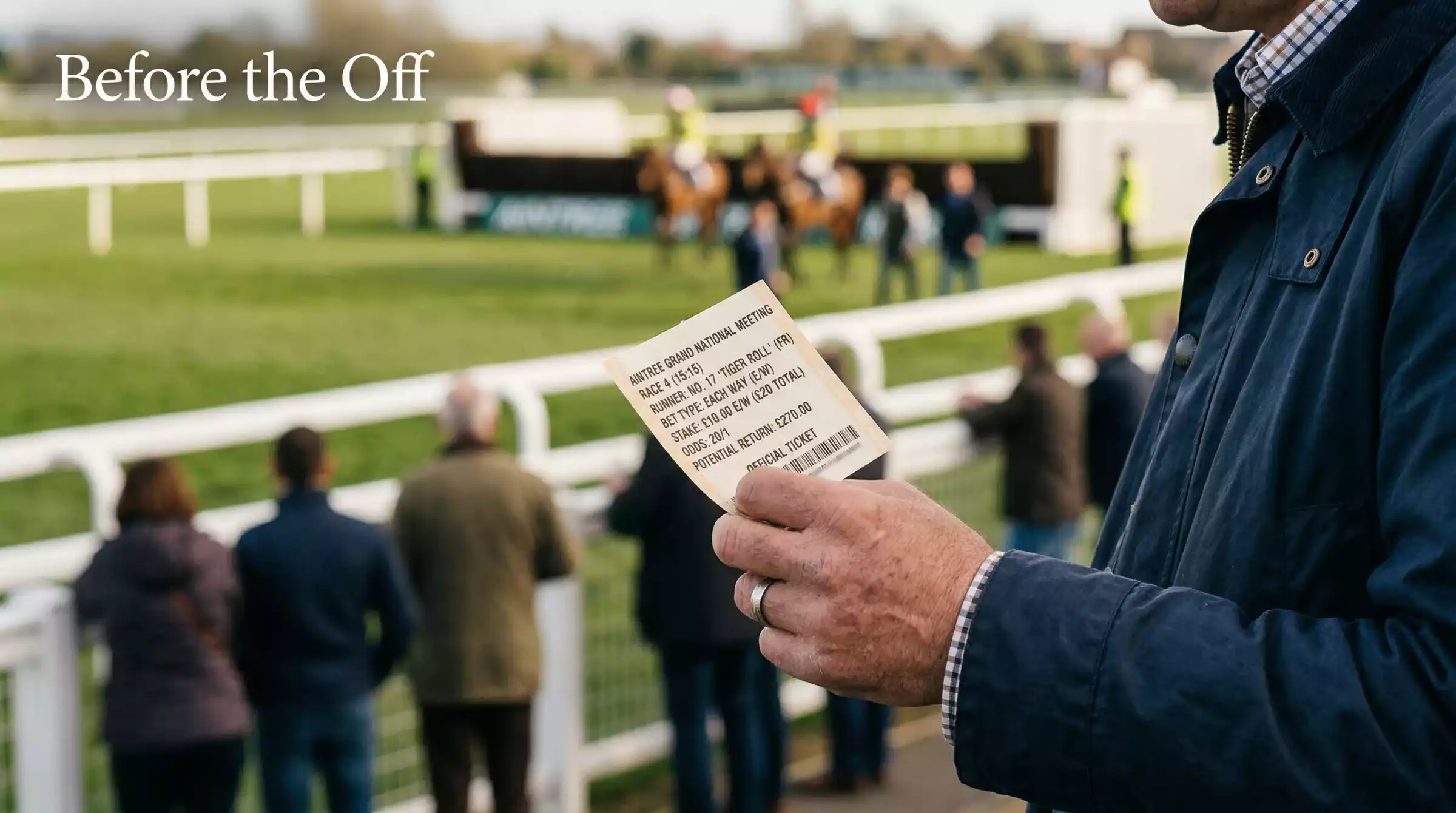
- Why Each-Way Dominates Grand National Betting
- The Anatomy of an Each-Way Bet
- Worked Examples: £10 Each-Way at Different Odds
- Understanding Place Fractions: 1/4 vs 1/5 Odds
- When Each-Way Makes Sense — and When It Doesn't
- Each-Way vs Win-Only: A Head-to-Head Comparison
- How Extra Places Change Your Returns
- Five Common Each-Way Mistakes to Avoid
- The Each-Way Bottom Line
Why Each-Way Dominates Grand National Betting
The Grand National is the one race in the British calendar where each-way betting is not just popular — it is the default. More punters back the National each-way than win-only, and by a wide margin. The reason is structural: in a 34-runner steeplechase where the average winning price over the past decade sits around 18.7/1, the chance of picking the outright winner from a single bet is small. The chance of picking a horse that finishes in the first four, five, or six places is considerably larger. Each-way betting captures both outcomes — two bets in one — and that dual coverage is precisely why it dominates the Grand National market. Each-Way Betting on the Grand National Explained — More on this topic at grand national place a bet.
The numbers bear this out. According to data from Entain and the Betting and Gaming Council, more than 80% of all bets on the 2025 Grand National were placed at stakes of £5 or less. Only 1% were at £20 or above. This is not a market driven by high-rollers making surgical win bets. It is a market of millions of casual punters staking modest amounts, looking for a realistic chance of getting something back. Each-way is the bet that gives them that chance. It is the bet that turns a long-shot flutter into a genuine proposition with multiple ways to collect.
If you have never placed an each-way bet before — or if you have but never fully understood the mechanics — this guide breaks it down from first principles. Every calculation, every scenario, every decision point. Two bets in one. That is where we start.
The Anatomy of an Each-Way Bet
An each-way bet is exactly what the phrase suggests: two bets in one. Half your total stake goes on the horse to win the race outright. The other half goes on the horse to finish in one of the designated place positions — typically the top four finishers in the Grand National, though bookmakers frequently extend this to five, six, seven, or even eight places as a promotional offer.
The critical thing to understand is that your total outlay doubles. A “£10 each-way” bet costs you £20: £10 on the win, £10 on the place. The two halves are settled independently. If your horse wins, both bets pay out — the win part at full odds, the place part at a fraction of the win odds. If your horse finishes in a place position but does not win, the win part loses and the place part pays. If your horse finishes outside the places, both bets lose.
The place part is paid at a fraction of the win odds, not at separate place odds. For the Grand National, the standard place fraction is one quarter (1/4) of the win odds, though some bookmakers offer one fifth (1/5). This fraction is fixed by the bookmaker before the race and applies to every each-way bet on the event.
Here is how it works in its simplest form. You back a horse at 20/1 each-way for £10. Your total stake is £20. The bookmaker pays four places at 1/4 odds.
The win part: £10 at 20/1. If the horse wins, this returns £210 — that is £200 profit plus your £10 stake back.
The place part: £10 at one quarter of 20/1, which is 5/1. If the horse places, this returns £60 — £50 profit plus your £10 stake back.
If the horse wins, you collect on both: £210 + £60 = £270 total from a £20 outlay. If the horse places but does not win, you collect only the place part: £60 from a £20 outlay, still a £40 profit. If the horse finishes outside the places, you lose your full £20.
Two bets in one. The win bet is the upside play. The place bet is the insurance. Together, they give you two separate chances to collect from a single selection — which, in a race where 34 horses are jumping 30 fences over four miles, is a meaningful structural advantage.
Worked Examples: £10 Each-Way at Different Odds
The value of an each-way bet changes dramatically depending on the odds of your selection. At short prices, the place fraction returns very little. At longer prices, the place part alone can deliver a handsome profit even when the horse does not win. To see this clearly, let us run the same £10 each-way bet (£20 total) through four different price points, all using standard Grand National terms: four places at 1/4 odds.
Horse at 4/1
Win part: £10 at 4/1 = £50 return (£40 profit + £10 stake). Place part: £10 at 1/1 (one quarter of 4/1 = evens) = £20 return (£10 profit + £10 stake). If it wins: £50 + £20 = £70 total, £50 profit. If it places only: £20 total, break-even on the place portion but you lose the £10 win stake, so net result is zero — you get your £20 back, nothing more. The place fraction at these odds is essentially a safety net that returns your total stake if the horse finishes in the top four. There is no profit from a place-only outcome.
Horse at 10/1
Win part: £10 at 10/1 = £110 return. Place part: £10 at 5/2 (one quarter of 10/1) = £35 return. If it wins: £110 + £35 = £145 total, £125 profit. If it places only: £35 total, £15 profit. Now the each-way structure starts to deliver genuine value on the place side. A horse finishing second, third, or fourth at 10/1 returns more than you staked.
Horse at 20/1
Win part: £10 at 20/1 = £210 return. Place part: £10 at 5/1 = £60 return. If it wins: £210 + £60 = £270 total, £250 profit. If it places only: £60 total, £40 profit. The place return here is three times the total stake — a result most punters would happily take from a horse that did not even win. This is the sweet spot for Grand National each-way betting: horses in the 14/1 to 25/1 range where the place fraction alone justifies the bet.
Horse at 33/1
Win part: £10 at 33/1 = £340 return. Place part: £10 at 33/4 (approximately 8.25/1) = £92.50 return. If it wins: £340 + £92.50 = £432.50 total, £412.50 profit. If it places only: £92.50 total, £72.50 profit. At 33/1, the place return alone is more than four times the total outlay. The 2025 Grand National was won by Nick Rockett at exactly this price — a result that rewarded each-way backers handsomely on both parts of the bet.
An estimated £250 million was wagered on the 2025 Grand National, with around £150 million of that coming from casual bettors who do not normally bet on horse racing. The overwhelming majority of those bets were each-way, and the majority were at stakes similar to the examples above — £5 or £10, placed in the hope that a horse at double-digit odds might find its way into the places. The worked examples show why: even without winning, the place return on a longer-priced selection can turn a small stake into a satisfying afternoon.
Understanding Place Fractions: 1/4 vs 1/5 Odds
The place fraction is the multiplier applied to the win odds to determine your place payout. For the Grand National, two fractions are commonly offered: one quarter (1/4) and one fifth (1/5). The difference sounds small on paper but is significant in practice, particularly at longer odds where the place part of the bet carries the most value.
At 1/4 odds, a horse priced at 20/1 pays 5/1 on the place. At 1/5 odds, the same horse pays 4/1. On a £10 place stake, that is the difference between a £60 return and a £50 return — £10 less profit for the same bet, same horse, same result. Multiply that across several bets over an afternoon, or scale it up to a larger stake, and 1/5 terms cost you real money relative to 1/4.
Why would anyone accept 1/5 odds? Because bookmakers offering 1/5 place fractions often compensate by paying more places. The trade-off is explicit: a lower payout per place position in exchange for more positions that qualify. A bookmaker offering eight places at 1/5 gives you double the number of qualifying positions compared to one offering four places at 1/4. If your horse finishes sixth at 20/1, the 1/5 eight-place offer pays £50 while the 1/4 four-place offer pays nothing.
The decision depends on where you think your horse will realistically finish. If you believe your selection has a genuine chance of finishing in the first four, the 1/4 fraction delivers more per place position and is mathematically superior. If you are backing a longer-priced outsider and simply want maximum coverage — the widest safety net possible — the extended places at 1/5 may serve you better, because the additional qualifying positions increase your probability of collecting something.
In practice, most major UK bookmakers offer 1/4 place fractions for the Grand National, with four places as the standard and enhanced offers extending to five, six, or seven. Betfred has historically offered eight places at 1/5 — the most places of any major operator, at the cost of a smaller fraction. The right choice is not universal. It is specific to your selection, your confidence level, and whether you prioritise payout size or payout probability.
One thing is consistent: you must check the place terms before placing your bet. The fraction and number of places are not standardised across the industry. They vary between bookmakers and can change in the days before the race. A two-minute comparison before you confirm your bet slip can add tangible value for zero additional cost.
When Each-Way Makes Sense — and When It Doesn’t
Each-way betting is not universally superior to win-only. It is a tool, and like any tool it has situations where it excels and situations where it is the wrong choice. The Grand National, with its large field and long odds, is the race where each-way excels most — but even here, the logic has limits.
Each-way makes sense when the odds are long enough for the place fraction to deliver a meaningful return. The threshold sits at roughly 5/1 and above. Below that, the place fraction returns so little that the doubled stake is not justified by the incremental safety. A horse at 3/1 each-way with 1/4 place fractions pays just 3/4 on the place — less than evens. Your £10 place stake returns £17.50, of which £10 is your own money back. The protection is marginal and the cost of doubling your outlay is real.
The average Grand National winner over the past decade has started at approximately 18.7/1, according to Betfair’s historical analysis. At those odds, the each-way structure delivers genuine value on both parts of the bet. The win part offers a large return for a correct prediction. The place part offers a profitable outcome even when the prediction is imperfect. In a race where the favourite has won only six times since 1999, the odds profile naturally favours each-way over win-only for the majority of selections.
Each-way does not make sense when you have strong conviction in a short-priced favourite and want maximum return from a correct prediction. Backing the 4/1 favourite each-way costs twice as much as backing it to win, and the place fraction at those odds is virtually meaningless. If you believe the favourite is going to win, a win-only bet is cleaner, cheaper, and returns more per pound staked.
It also does not make sense when your budget is very small and the doubling effect matters. If you can only afford £5 total and your selection is at 20/1, a £5 win bet returns £105 if it wins. A £2.50 each-way bet (£5 total) returns £52.50 + £15 = £67.50 if it wins, or £15 if it places only. The win-only bet gives you a bigger upside for the same outlay. The each-way bet gives you a lower upside with the consolation of a modest place return. Which is better depends on whether you value upside or insurance — but at very small stakes, the insurance can feel like it costs more than it is worth.
Each-Way vs Win-Only: A Head-to-Head Comparison
The simplest way to see the difference is to run the same budget through both bet types on the same horse.
Suppose you have a £20 Grand National budget and you fancy a horse at 16/1. Standard terms: four places, 1/4 odds.
Option A: £20 win-only at 16/1. If it wins: £340 return (£320 profit). If it places: £0. If it finishes outside the places: £0. Total outlay: £20.
Option B: £10 each-way at 16/1. Win part: £10 at 16/1 = £170 return. Place part: £10 at 4/1 = £50 return. If it wins: £170 + £50 = £220 return (£200 profit). If it places: £50 return (£30 profit). If it finishes outside the places: £0. Total outlay: £20.
The win-only bet returns £120 more when the horse wins. The each-way bet returns £50 when the horse places but does not win — a scenario where the win-only bet returns nothing. The trade-off is £120 of upside for £50 of insurance. In probability terms, you are exchanging a larger payout on the less likely outcome (winning outright) for a smaller payout on a more likely outcome (placing).
In the Grand National specifically, the probability of a horse finishing in the first four is considerably higher than the probability of it winning. A horse at 16/1 has an implied win probability of about 5.9%. Its implied probability of finishing in the top four in a 34-runner field is significantly higher — not precisely calculable from win odds alone, but empirically the Grand National produces placed finishers at longer prices than most races due to the attrition caused by fallers and non-finishers.
For a once-a-year punter with a fixed budget and no edge in selecting winners, the each-way bet is the more efficient use of capital in most Grand National scenarios. It converts a race with a roughly 3-6% chance of picking the winner into one with perhaps a 12-20% chance of collecting something. The return on a place-only outcome is lower, but the probability of that return is materially higher. Over many years of Grand National betting, the each-way approach will produce more winning weekends than win-only at the same budget — though the peak payouts will be smaller.
For the punter who has done serious homework and has strong conviction in a specific horse at a price they consider value, win-only preserves the full upside and does not dilute the stake across two outcomes. Both approaches are valid. The question is not which is better in absolute terms but which matches your situation: your budget, your confidence, and your appetite for risk on the first Saturday in April.
How Extra Places Change Your Returns
Every major bookmaker offers enhanced each-way terms for the Grand National. The standard is four places at 1/4 odds, but promotional competition pushes many operators to five, six, seven, or eight places. These extra places are not cosmetic. They change the mathematics of your bet in ways that are worth understanding before you choose where to place it.
The core effect is simple: more places means more finishing positions that generate a payout on the place part of your each-way bet. In a 34-runner race, the difference between four and eight places roughly doubles the number of qualifying positions, which approximately doubles your probability of collecting on the place fraction. A horse that finishes seventh returns nothing on four-place terms. On eight-place terms, that same horse pays out in full on the place part.
To put numbers on it: your horse at 20/1 each-way for £10 (£20 total), with 1/4 place fractions. On four-place terms, the horse must finish first through fourth to trigger the place part. On eight-place terms, it must finish first through eighth. The place payout is the same either way — £60 — but the probability of collecting it is materially higher with eight places.
The Grand National’s unique characteristics amplify this effect. The race has a high attrition rate: typically between a third and half the field does not complete the course due to falls, unseats, refusals, or being pulled up. In a 34-runner race where 12-15 horses fail to finish, the eighth-place finisher might effectively be eighth out of 20 completers — a far less improbable outcome than eighth out of 34 starters.
Since 1999, only six pre-race favourites have won the Grand National: Hedgehunter (2005), Comply Or Die (2008), Don’t Push It (2010), Tiger Roll (2019), Corach Rambler (2023), and I Am Maximus (2024). The remaining 20 winners went to horses at double-digit prices, often finishing alongside other long-priced horses in the places. Extended place terms capture more of these outcomes. According to the Gambling Commission’s annual report, the remote gambling market is growing at over 13% year-on-year, and the competitive pressure between operators to attract Grand National bets drives increasingly generous enhanced place offers.
The practical advice is to shop around in the fortnight before the race. Compare the number of places and the fraction offered by each bookmaker. A two-minute comparison can be the difference between a payout and a losing bet — same horse, same race, different outcome based solely on where you placed the bet.
Five Common Each-Way Mistakes to Avoid
Each-way betting is straightforward in principle but punters consistently make the same errors, often because the mechanics are explained poorly or not at all. Here are the five that cost people money on Grand National day, year after year.
Mistake one: not realising the stake doubles. A £10 each-way bet costs £20, not £10. This catches first-time bettors more than anyone. You tap “£10” into the bet slip, tick the each-way box, and your total outlay doubles to £20. If your budget for the afternoon is £20, an each-way bet at “£10” uses all of it. Check the total before confirming. The bet slip will display it — read it.
Mistake two: backing short-priced favourites each-way. As we covered above, the place fraction at short odds returns very little. Backing the 3/1 favourite each-way is a poor use of the doubled stake. If you fancy the favourite, back it to win. Save the each-way approach for horses at 8/1 and above, where the place fraction starts to deliver meaningful returns.
Mistake three: ignoring the place terms. Not all bookmakers offer the same number of places or the same fraction. You might assume four places at 1/4 is standard and bet accordingly, only to discover your bookmaker is paying 1/5 — which, on a £10 each-way bet at 20/1, costs you £10 in place returns compared to the 1/4 alternative. Check the terms. They are displayed on the bet slip and in the race promotion terms for every operator.
Mistake four: placing each-way bets in accumulators without understanding the maths. An each-way accumulator is not the same as a win accumulator with place protection. It generates two separate accumulators: one on all selections to win, another on all selections to place. If one horse wins and the others only place, you lose the win accumulator and collect only on the place accumulator — which, in a multi-leg acca, often returns disappointingly little. For the Grand National, keep each-way bets as singles. Accumulators belong to a different strategy entirely.
Mistake five: betting each-way on too many horses. The temptation in a 34-runner race is to back five or six horses each-way for £5 each — a total outlay of £50 to £60. The problem is that your place returns at 1/4 fractions need to exceed your total stake to produce a profit. If one of your six horses places at 16/1 on standard four-place terms, the place return is £25 from a £5 place stake. But your total outlay across all six bets is £60. You have lost £35 on the afternoon despite having a placed horse. Spreading each-way bets too thinly dilutes each individual bet below the profit threshold. Two or three well-researched each-way selections, at stakes that produce meaningful returns, will outperform six scattered flutter bets.
“We’re expecting plenty of betting interest up and down the country and could see turnover on the race north of £150 million. It’s a huge week at Aintree, where total betting turnover for the three days could comfortably hit a quarter of a billion.” — Lee Phelps, spokesperson, William Hill
With that volume of money flowing into the market, the bookmakers’ Grand National each-way terms are among the most competitive of the year. The mistakes above are avoidable. The value is there. The only question is whether you capture it or leave it on the table.
The Each-Way Bottom Line
Each-way is not a complicated bet. It is two bets in one: win and place, settled independently, with the place part paid at a fraction of the win odds. It costs twice your nominal stake. It pays out when your horse wins or places. It pays nothing when your horse finishes outside the places. That is the entire mechanism. See also How to Read Grand National Odds and Find Value.
In the Grand National, where 34 horses race over four miles and 30 fences, each-way is the structurally optimal bet for the casual punter. The long average winning price makes the place fraction profitable at most realistic odds. The high attrition rate increases the probability of a placing finish. And the intense bookmaker competition around the race means enhanced place terms are available if you look for them. Back a horse in the 10/1 to 33/1 range each-way, at a stake you are comfortable losing, with a bookmaker offering the best available place terms. That is the each-way playbook for the Grand National — and it has been the right approach for as long as the race has existed.
