 Available in US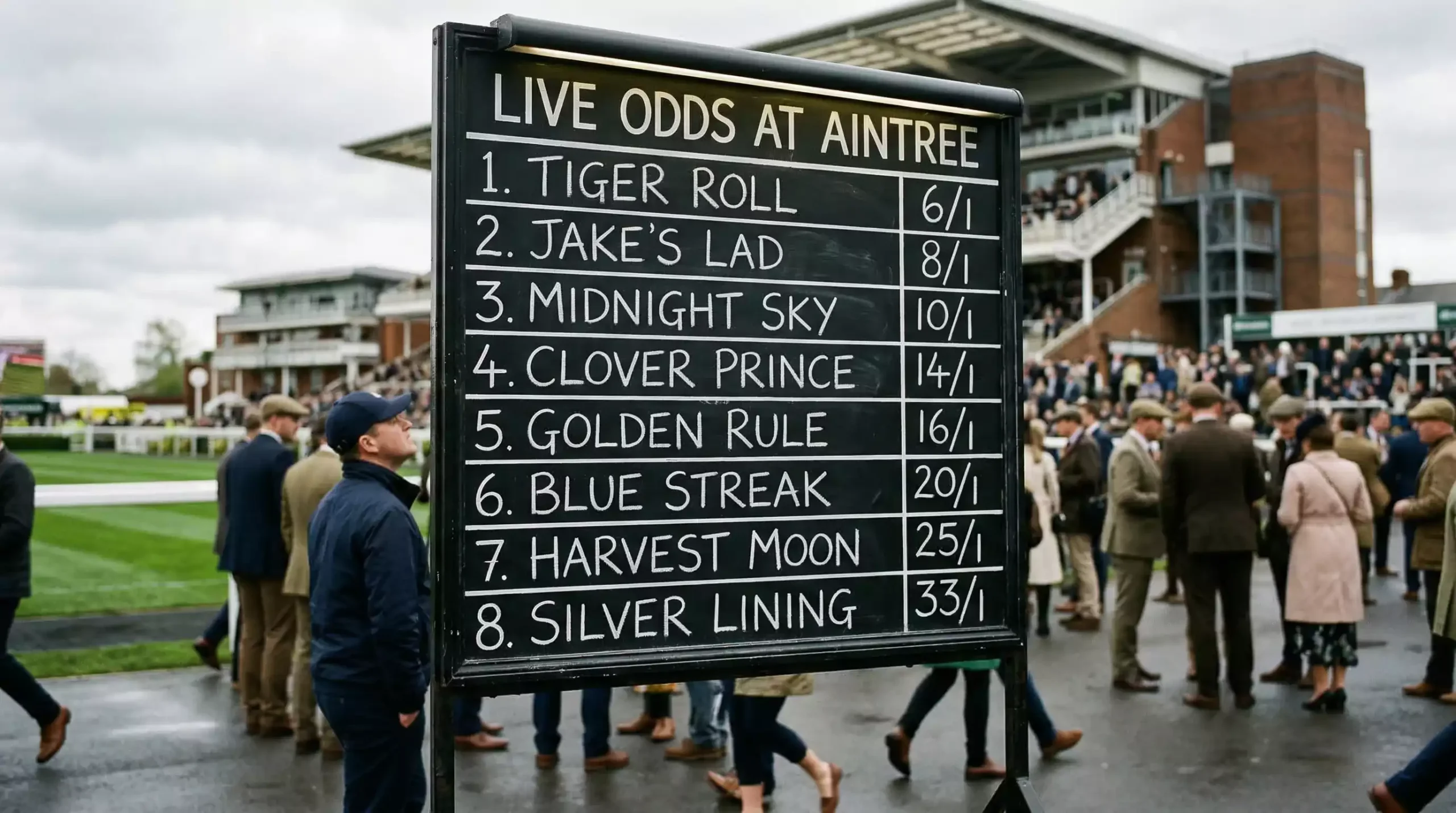
- What Grand National Odds Tell You — and What They Don't
- Fractional vs Decimal: Two Languages for the Same Price
- How Bookmakers Build the Grand National Book
- The Overround: Why the House Always Has an Edge
- Starting Price vs Early Price: Which Is Better?
- How to Spot Value in Grand National Markets
- Why Grand National Odds Move Before the Race
- Comparing Odds Across Bookmakers
What Grand National Odds Tell You — and What They Don’t
Every number next to a horse’s name in the Grand National market is a compressed opinion. It represents the bookmaker’s assessment — informed by money, form, conditions, and a century of institutional knowledge — of how likely that horse is to win. A horse at 6/1 is considered roughly six times less likely to win than the theoretical certainty of a dead heat among all runners. A horse at 33/1 is considered a remote chance but not an impossibility. Reading the market means understanding what those numbers encode, and — just as importantly — what they leave out. How to Read Grand National Odds and Find Value — More on this topic at grand national place a bet.
The Grand National betting market is one of the largest in British sport. Remote horse racing betting alone generated £766.7 million in gross gaming yield during the 2024/25 financial year, making it the second-largest sport for online betting in the UK after football. The Grand National accounts for a disproportionate share of that total — a single Saturday afternoon that attracts more wagers than most sports manage in a month. That volume of money creates a deep, liquid market where prices carry real information. But it also creates a market where the bookmaker’s edge is baked into every price, and where the casual punter needs to understand the mechanics to avoid paying more for their bet than necessary.
This guide is about reading the market. Not predicting winners — nobody can do that reliably in a 34-runner steeplechase — but understanding what the odds are telling you, how they are constructed, and where the genuine value sits in a race where 18.7/1 is the average winning price.
Fractional vs Decimal: Two Languages for the Same Price
British horse racing has used fractional odds since long before anyone thought to put betting on a screen. Odds of 10/1 mean you receive £10 in profit for every £1 staked, plus your stake back. Odds of 7/2 mean £7 profit for every £2 staked. The first number is always the profit. The second is the stake required to earn it. Your total return is both numbers added together, divided by the second, multiplied by your actual stake.
In practice, the mental arithmetic for common fractions becomes second nature: 2/1 triples your money, 4/1 quintuples it, 10/1 returns eleven times your stake. The fractions that trip people up are the non-standard ones: 11/4, 9/2, 100/30. These are functionally identical to simpler expressions (11/4 is the same as 2.75/1) but they exist because they allow bookmakers to set prices at finer increments than whole numbers permit.
Decimal odds, dominant in Europe and increasingly common on UK betting apps, express the same information more intuitively. The decimal number is your total return per pound staked, including the stake. So 10/1 fractional = 11.0 decimal (you get back £11 for every £1 bet). 7/2 fractional = 4.5 decimal. 100/30 fractional = 4.33 decimal. The conversion formula is straightforward: divide the first fractional number by the second, then add 1.
Decimal odds make two things easier. First, comparing prices across bookmakers: is 11/4 at one bookmaker better or worse than 2.85 at another? Convert: 11/4 = 3.75. So 2.85 is worse. In decimal, the comparison is instant. Second, calculating accumulator returns: you multiply decimal odds together. Three selections at 3.0, 4.5, and 6.0 return 3.0 x 4.5 x 6.0 = 81.0 times your stake. Try doing that in fractional notation without a calculator.
Most UK bookmaker apps now display both formats, with a toggle in the settings. For Grand National betting, where you may be comparing prices across six or seven operators in the days before the race, switching to decimal is a practical advantage. It does not change the bet. It changes how quickly you can read the market — and in a race where odds move by the hour in the final week, speed of reading matters.
One quirk worth noting: the favourite’s price in the Grand National is often expressed as a fractional fraction — 6/1, 7/1, 8/1 — while outsiders may be quoted as 25/1, 33/1, 40/1, or even 100/1. In decimal, these become 7.0, 8.0, 9.0, 26.0, 34.0, 41.0, and 101.0 respectively. The symmetry in decimal makes the enormous spread of the Grand National market — from single-digit to triple-digit — visually clear in a way that fractional notation somewhat obscures.
How Bookmakers Build the Grand National Book
A bookmaker’s odds are not predictions. They are prices — set to attract balanced action across the field so that the bookmaker profits regardless of which horse wins. The process of building the Grand National book starts months before the race and involves layers of assessment that most punters never see.
The initial ante-post market is based on form analysis, handicap ratings, trainer patterns, and the bookmaker’s own trading team assessments. These early prices — available from the autumn before the race — are wide and speculative, reflecting high uncertainty about which horses will ultimately run. As the race approaches and entries are confirmed, the prices tighten. Weights are announced in February, typically prompting a significant market reshuffle as traders assess which horses have been treated generously by the handicapper and which face an unrealistic burden.
The final declarations stage, usually 48 hours before the race, produces the market that most casual punters see first. By this point, the field is confirmed at 34 runners, the weights are known, the going is roughly established, and the jockey bookings are finalised. The bookmaker’s trading team prices up the full field, and from that moment until the off, the prices move in response to money. When punters back a horse, its price shortens (gets smaller). When money moves away, it drifts (gets bigger).
The structural backdrop to all of this is a UK betting industry that has consolidated significantly. The number of licensed betting premises in Britain has fallen to 5,825 — a decline of 36% over the past decade, according to the Gambling Commission’s 2024/25 annual report. The high-street shop is shrinking. The online market — where Grand National prices are set by sophisticated trading algorithms as much as by human judgement — is where the action is. The bookmaker building the Grand National book in 2026 is not a man with a satchel and a chalk board at Aintree. It is a team of traders, analysts, and automated pricing systems working in real time, adjusting thousands of prices across dozens of markets as money flows in from millions of punters.
What this means for you: the Grand National market is efficient. Not perfectly efficient — there are edges to be found, and we will get to those — but efficient enough that the prices you see broadly reflect the collective intelligence of the betting market. A horse at 10/1 is not priced there by accident. It is priced there because the weight of money and analysis says it has roughly a 9-10% chance of winning. Your job, as a bettor, is not to outguess the market on every horse. It is to find the one or two horses where you believe the market has it wrong — where the true probability is higher than the price implies.
The Overround: Why the House Always Has an Edge
If you converted every horse’s odds in the Grand National into an implied probability and added them all up, the total would not be 100%. It would be somewhere between 120% and 150%, depending on the bookmaker and how competitive their pricing is. That excess over 100% is the overround — the bookmaker’s built-in profit margin on the race.
To convert odds to implied probability: divide 1 by the decimal odds. A horse at 10/1 (decimal 11.0) has an implied probability of 1/11 = 9.09%. A horse at 33/1 (decimal 34.0) has an implied probability of 1/34 = 2.94%. Add up the implied probabilities for all 34 runners and the total will exceed 100%. If it totals 130%, the overround is 30% — meaning the bookmaker has priced the market as if there is a 130% chance that something will happen when, by definition, the true total probability is exactly 100%.
In practical terms, a 130% book means the bookmaker expects to retain roughly 23p of every pound staked, before expenses, taxes, and payouts to winners. The higher the overround, the worse the value for punters across the market as a whole. The lower the overround, the closer the odds are to the true probabilities.
Grand National overrounds vary considerably between bookmakers. Online operators with low overheads and intense competition tend to offer tighter books — overrounds of 115-125% on the Grand National win market. High-street bookmakers, working with smaller margins and higher fixed costs, may price at 130-140%. The exchange markets, where punters bet against each other rather than against a bookmaker, have the lowest effective overrounds — sometimes as little as 102-105% before commission — but the liquidity on individual Grand National runners can be thinner than with a traditional bookmaker.
The overround is not evenly distributed across the field. Bookmakers typically shade the prices of popular runners — the favourite and second favourite — more aggressively, because those horses attract the most money and any reduction in their odds saves the bookmaker the most in potential payouts. The longer-priced runners, which attract less volume, are often more fairly priced. This creates a systematic pattern: the value in the Grand National market is more likely to be found at 14/1 and above than at 6/1. It is one reason why backing outsiders each-way has historically been a more productive Grand National strategy than backing favourites to win.
Starting Price vs Early Price: Which Is Better?
The Starting Price (SP) is the official odds of each horse at the moment the Grand National starts. It is determined by on-course bookmakers at Aintree using a regulated process and serves as the default settlement price for any bet placed without specifying odds. If you walk into a betting shop and ask for “a fiver on Horse X in the National” without naming a price, your bet is settled at SP.
The early price — also called the board price or fixed price — is the odds you lock in at the time you place your bet. If you take 20/1 on Monday and the horse drifts to 25/1 by Saturday, you are paid at 20/1. If it shortens to 12/1, you are still paid at 20/1. The price is fixed at the moment of the bet.
In Grand National betting, where markets move substantially in the final days before the race, the question of SP versus early price matters more than in most races. The average winning price over the past decade is approximately 18.7/1 — but that figure is the SP. The early prices taken on those same winners were often different, sometimes significantly so.
Best Odds Guaranteed (BOG) has largely resolved this dilemma for punters who bet online. BOG means that if you take an early price and the SP is higher, the bookmaker pays you at the better price. If the SP is lower, you keep your original price. BOG eliminates the downside of taking an early price while preserving the upside. Virtually every major UK bookmaker offers BOG for the Grand National, and using it is one of the simplest free advantages available to punters.
The practical advice, then, is to take the price rather than leaving your bet at SP — provided BOG is available. You lock in the current odds with no risk of getting a worse price on the day, while retaining the benefit of any price improvement. The only scenario where SP is preferable is if you are betting on-course at Aintree, where BOG does not apply and the market on the day may offer a better price than the morning quote. But for the millions of punters betting online, BOG makes the early price the objectively superior choice in almost every circumstance.
How to Spot Value in Grand National Markets
Value in betting exists when the true probability of an outcome is higher than the implied probability of the odds. If you believe a horse has a 10% chance of winning and the bookmaker offers 14/1 (implied probability 6.7%), there is value in backing that horse. You may still lose — a 10% probability means it loses nine times out of ten — but over repeated bets at value odds, the maths works in your favour.
In the Grand National, value identification is harder than in most races because the field is large, the variables are numerous (weight, age, going, fences, luck), and the market is deeply liquid. But the difficulty is also the opportunity. The sheer number of runners means the market cannot price every horse perfectly. Mispricings exist, particularly in the 14/1 to 33/1 range where horses attract less analytical attention than the market leaders.
“Given the open nature and big odds available across the field, we’re expecting plenty of betting interest up and down the country and could see turnover on the race north of £150 million. It’s a huge week at Aintree, where total betting turnover for the three days could comfortably hit a quarter of a billion.” — Lee Phelps, spokesperson, William Hill
That openness is precisely where value hides. When a market is wide — when six or seven horses could plausibly win and none is shorter than 6/1 — the bookmaker is spreading risk across many runners, and the probability distribution is flatter than in a race with a clear favourite. Flat probability distributions produce more mispricings because the bookmaker is pricing 34 separate outcomes with limited data on several of them.
Practical value-spotting in the Grand National involves a few specific steps. First, identify horses that fit the historical winner profile — eight or nine years old, carrying 10st 2lb to 10st 13lb, with form over three miles or more and clean jumping records — and check whether their current price reflects that profile. A horse that ticks every box but is available at 20/1 because it lacks a fashionable name or a high-profile trainer connection may be underpriced relative to its chances.
Second, watch for horses whose prices have drifted late without any negative news (withdrawal, poor trackwork, unfavourable going change). Late drift without cause can indicate that the bookmaker is managing liability on more popular runners and has allowed the less popular ones to drift out, creating value by default rather than design.
Third, compare prices across bookmakers. A horse at 16/1 with one operator and 20/1 with another is worth backing at 20/1 — not because 20/1 is inherently the “right” price, but because one bookmaker is offering more generous odds for the same risk. This is not sophisticated analysis. It is shopping. And in a market with dozens of operators competing for your Grand National stake, the price dispersion on individual horses can be substantial.
Why Grand National Odds Move Before the Race
Grand National odds are not static. They move — sometimes dramatically — in the weeks and days before the race. Understanding why they move is essential for reading the market rather than merely reacting to it.
The most common reason for odds shortening is money. When punters back a horse, the bookmaker takes on liability at that price. If too much money arrives on one runner, the bookmaker shortens its odds to discourage further backing and to improve the payout ratio on what is now a heavily-backed selection. The reverse happens when money moves away: the price drifts longer to attract new interest. This is not manipulation. It is supply and demand in a live market, and the price movements carry information about where informed money is going.
Non-runners are the second major driver of odds movement. When a horse is withdrawn from the Grand National — whether due to injury, illness, trainer decision, or unsatisfactory going conditions — the remaining horses’ odds shorten proportionally. This is formalised in the Rule 4 deduction system, which adjusts payouts on bets already placed to account for the removed runner’s implied probability. A late withdrawal of the favourite can cause widespread market disruption, with multiple horses shortening significantly in a matter of minutes.
Going conditions matter too. The official going at Aintree is updated several times during Grand National week. A change from good to soft overnight — after unexpected rain, for example — will cause horses known to prefer soft ground to shorten and those that need fast ground to drift. Trainers may withdraw their horses based on the going report, compounding the price movement with a non-runner effect on top of the conditions-based repricing.
The broader market context adds pressure. Total betting turnover on British horse racing fell 4.2% in the first nine months of 2025 compared to the previous year, according to the BHA, with the decline concentrated outside of major festivals. The Grand National is one of the few fixtures where turnover remains robust — which means more money flows into the market and prices move more sharply than for everyday racing. The gap between the Monday price and the Saturday SP can be substantial: horses that were 25/1 on Monday have been known to start at 12/1, and vice versa.
For punters, the key question is whether to bet early or late. Early prices lock in a potentially generous number before the market tightens. Late prices benefit from the most current information about going, non-runners, and market sentiment. With Best Odds Guaranteed, the decision is straightforward: take the early price, keep the upside of any late improvement, and avoid the anxiety of watching your horse’s price halve in the final 48 hours because a wave of informed money arrived.
Comparing Odds Across Bookmakers
The Grand National is one of the most competitive betting markets of the year, which means prices vary between operators more than you might expect. Two bookmakers pricing the same horse can differ by two or three points on the odds — the difference between 16/1 and 14/1, or 25/1 and 20/1. On an each-way bet, that discrepancy affects both the win return and the place return, magnifying the impact of choosing the right operator.
The simplest comparison method is manual: open three or four bookmaker apps, find the Grand National market, and compare the price on your selected horse. It takes two minutes. The bookmaker offering the best odds — the highest number in fractional terms, the highest decimal number — is where you should place the bet, all else being equal.
Odds comparison websites aggregate prices from dozens of operators and display them side by side. These sites are useful for a quick scan but come with caveats. Not all operators are listed. The prices may update with a slight delay. And the comparison is on the headline odds only — it does not account for place terms (a horse at 20/1 with eight places at one bookmaker may be better value than 22/1 with four places at another), BOG eligibility, or promotional extras like faller refunds. Use comparison sites as a starting point, not the final word.
The exchange market — Betfair being the dominant platform — deserves separate attention. Exchange odds are set by other punters, not by a bookmaker. The prices are typically more generous because the exchange takes a small commission (usually 2-5%) on net winnings rather than building an overround into every price. A horse offered at 20/1 by a traditional bookmaker may be available at 24/1 or higher on the exchange. The trade-off is that exchange liquidity on individual Grand National runners can be limited until close to race time, and the place market on exchanges is often thinner than the win market. See also Grand National Runners and Form Guide 2026.
For the typical Grand National punter — one bet, each-way, on a Saturday afternoon — the practical approach is to identify your horse first, then shop for the best price across three or four operators you already have accounts with. If you do not have multiple accounts, the weeks before the Grand National are the best time of year to open them: sign-up offers are at their most competitive, and you gain permanent access to price comparison for future bets. The horse you back matters most. But where you back it matters too — and the difference in price between the best and worst operator on the same horse, in the same race, is often the difference between a good bet and a mediocre one.
