 Available in US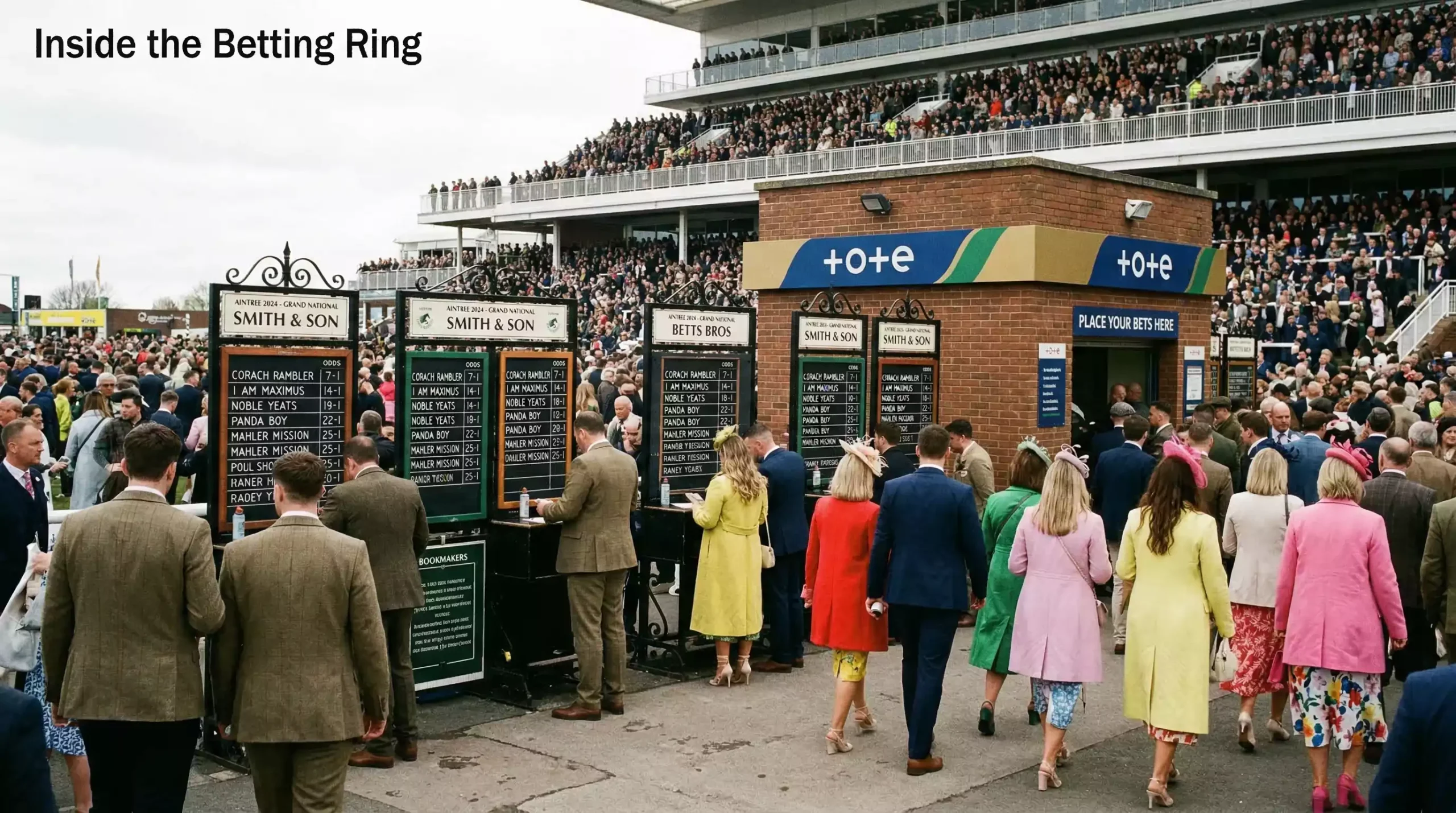
- What's Different About Betting at Aintree
- How the Tote Works: Pool Betting in 60 Seconds
- Tote Bet Types: Win, Place, Exacta, Trifecta, Swinger
- The Placepot: Six Races, One Bet, Big Potential
- Lucky Pick Wallets: The Easiest Way to Bet On-Course
- On-Course Bookmakers: Fixed Odds at the Track
- Tote vs Bookmaker: Which Suits Your Style?
- On-Course Betting: Practical Tips for Raceday
What’s Different About Betting at Aintree
Betting on the Grand National from a phone is fast, quiet, and efficient. Betting at Aintree is none of those things — and that is entirely the point. The racecourse experience is louder, slower, more social, and more tactile than anything a screen can replicate. There is a Tote kiosk queue, a wall of bookmaker boards shouting prices in chalk, a crowd of 70,000 people pressed into a grandstand that smells of turf and adrenaline, and a four-mile race unfolding in front of you at a distance close enough to hear the horses’ hooves on landing. Betting on the Grand National at Aintree — More on this topic at grand national place a bet.
Betting on-course also works differently from betting online. The options are broader in some ways — pool bets like the Placepot, which are designed for a day at the races — and narrower in others: there is no cash-out button, no live streaming (you are the live stream), and no price comparison tool except your own legs carrying you from one bookmaker’s pitch to the next.
According to the BHA’s 2025 Racing Report, total racecourse attendance across Britain reached 5.031 million in 2025 — up 4.8% on the previous year and the first time the figure exceeded 5 million since 2019. The Aintree Festival is one of the biggest contributors to that total, with Grand National day drawing one of the largest single-day crowds in British sport. For the tens of thousands attending, the betting experience is part of the day out — and getting it right requires understanding the two distinct systems operating on-course: the Tote and the bookmakers.
How the Tote Works: Pool Betting in 60 Seconds
The Tote is the UK’s pool betting operator, and at Aintree it runs the largest pool bets of the year. The principle is simple: instead of betting against a bookmaker at fixed odds, your stake goes into a shared pool with everyone else who has bet on the same market. After the race, the pool is divided among the winners. Your payout depends on how many people backed the same outcome — the fewer winners, the bigger the dividend.
You do not know your payout when you place the bet. This is the fundamental difference from fixed-odds betting. With a bookmaker, you see the price (10/1, 20/1) and know exactly what you will receive if you win. With the Tote, the dividend is declared after the race, once the pool has been calculated. It might be more generous than the bookmaker price, or less — it depends entirely on where the money went. On popular runners, the Tote dividend is usually similar to or slightly below the starting price, because a lot of money flows to the same horse. On less popular runners, the Tote dividend can significantly exceed the SP — sometimes dramatically so — because fewer people backed that outcome and the pool division is more generous.
On-course, the Tote operates through kiosks, self-service betting terminals, and roving staff with handheld devices. The minimum bet is £2 — lower than most bookmaker minimums — and bets are placed by selecting a race, a horse, a bet type, and a stake. No account is required. You receive a paper ticket or a digital receipt, and you collect winnings from any Tote outlet after the race. It is deliberately accessible: designed for the once-a-year racegoer as much as the regular punter.
The Tote takes a commission — a percentage deducted from the pool before dividends are calculated — and this commission is the equivalent of the bookmaker’s overround. It is transparent and published. The remaining pool is distributed in full to winning ticket holders. On Grand National day, when the pools are at their largest, the dividends can be substantial. The size of the pool amplifies the payouts on less popular outcomes because the pot is bigger and fewer people are sharing it.
If you have never placed a Tote bet before, the kiosk interface walks you through each step. Arrive early enough to place a practice bet on the first race of the afternoon — the process is identical for every race, so by the time the Grand National comes around you will know exactly what you are doing. Tote outlets are distributed throughout the Aintree enclosures, and on Grand National day the queues build from early afternoon. Placing your Grand National Tote bets before the rush — ideally before the second race — avoids the bottleneck that catches people out every year.
Tote Bet Types: Win, Place, Exacta, Trifecta, Swinger
The Tote offers several bet types, each drawn from its own pool. The simplest are Totewin and Toteplace. Totewin is a bet on a horse to win the race outright. Toteplace is a bet on a horse to finish in the designated places — for the Grand National, the Tote typically pays the first four. Both work like their bookmaker equivalents, except the payout is determined by pool division rather than fixed odds.
The Exacta requires you to predict the first two finishers in the correct order. In a 34-runner Grand National, the number of possible combinations is 34 multiplied by 33 — 1,122 possible Exacta outcomes. The difficulty is extreme. The payouts reflect it: Grand National Exacta dividends routinely reach hundreds of pounds from a £1 stake, and in years with an unexpected result they can run to four figures. You can also bet the Exacta as a combination (any order), which covers both possible sequences but costs two unit stakes instead of one.
The Trifecta extends the Exacta to three horses: first, second, and third in exact order. There are 35,904 possible Trifecta combinations in a 34-runner field. The dividends can be enormous — Grand National Trifecta payouts in the thousands are not uncommon, and five-figure returns have been recorded. A combination Trifecta on three horses costs six units (all possible orderings). On four horses it costs 24 units. On five, 60 units. The maths escalates quickly, so keeping your selections tight is essential unless you are prepared to spend accordingly.
The Swinger is unique to the Tote — no direct fixed-odds equivalent exists at most bookmakers. You pick two horses to finish in the first three, in any order. It does not matter whether they are first and second, first and third, or second and third. As long as both appear somewhere in the top three, you collect. The Swinger is more forgiving than the Exacta because it requires no specific order and your horses do not need to fill the top two spots — they just need to be in the first three. For the Grand National, where the places are contested by a wide spread of runners, the Swinger is an appealing middle ground between a simple place bet and the precision required for an Exacta.
All Tote bets can be placed from £1 per unit (£2 minimum total stake). The Tote declares its dividends after each race as a return per £1 unit — for example, a Totewin dividend of £22.50 means a £1 bet returns £22.50 in total. A £2 bet at the same dividend returns £45. Dividends are displayed on screens around the course and published online within minutes of each result.
The Placepot: Six Races, One Bet, Big Potential
The Placepot is the Tote’s signature bet and one of the most popular wagers at any British race meeting. It requires you to select a horse to place in each of the first six races on the card — not just the Grand National. The pool is shared among everyone who successfully picks a placed horse in all six races. Miss one, and you are out.
On Grand National day, the Placepot pool is one of the largest of the year. Tens of thousands of punters contribute, and the resulting dividend can be substantial even when many people collect. In years where an upset hits one of the early races and thins the surviving tickets, the dividend can be enormous — hundreds or even thousands of pounds from a £1 stake.
The strategy for a Grand National day Placepot starts with understanding that the earlier races on the card are your biggest risk. These are supporting races — competitive handicaps and novice chases — where the form is harder to assess and the field sizes can be large. Getting through races one to five is the real challenge. The Grand National itself, as the sixth race, is where you need one more placed horse to collect — and with four or more places typically paid, the probability of surviving the final leg is higher than the preceding ones.
Permutation betting helps manage the risk. Instead of selecting one horse per race, you can select two or three — but each additional selection multiplies your total cost. One horse per race for six races costs £1 (one line). Two horses in one race and one in each other costs £2. Two horses in two races and one in the rest costs £4. The combinations multiply, so the art of Placepot betting is balancing coverage (more horses per race) against cost (more lines), concentrating your extra selections in the races where the result is hardest to predict.
The Grand National’s impact extends beyond the betting ring. A study by Liverpool Business School estimated that the 2022 Grand National generated over £60 million for the local Liverpool economy, with the three-day festival bringing tens of thousands of visitors, filling hotels, restaurants, and transport. The Placepot is a small but genuine part of that ecosystem — a bet that keeps punters engaged across the entire afternoon rather than just the headline race, sustaining interest in the undercard and the raceday experience as a whole.
Lucky Pick Wallets: The Easiest Way to Bet On-Course
If the array of Tote bet types and permutations sounds overwhelming, the Lucky Pick wallet is designed specifically for you. It is the simplest way to bet on-course at Aintree, requiring no knowledge of odds, form, or pool mechanics.
A Lucky Pick wallet is a pre-loaded card containing a random selection for a specific Tote bet — typically the Placepot. You buy one from a Tote kiosk or vendor, and the selections have already been made for you by random allocation. If the randomly assigned horses place in their respective races, you win your share of the pool. You do not choose the horses. You do not need to study the racecard. You simply buy the wallet, watch the races, and check whether your card is a winner at the end of the afternoon.
Lucky Pick wallets are priced accessibly — usually £2 to £5 — and are popular with racegoers who are at Aintree for the spectacle rather than the betting strategy. They are an entry point: a way to have a bet on every race without committing to the analytical work that a manual Placepot requires. The randomness is the feature, not the bug. In a sport where the entire Grand National field carries the possibility of a shock result, letting chance pick your horses is not inherently less rational than making an informed selection — it is simply less effortful, and for many people at the racecourse for a day out, that is exactly the trade-off they want.
The wallets also serve a social function. Groups of friends can each buy a Lucky Pick and compare selections, turning the afternoon into a shared experience where everyone has a stake in every race. It converts the Placepot from a solitary analytical exercise into a communal one — which, at Aintree on Grand National day, is entirely appropriate.
On-Course Bookmakers: Fixed Odds at the Track
On-course bookmakers are the traditional alternative to the Tote. They stand in the betting ring at Aintree, displaying odds on boards and taking bets at fixed prices. When you bet with an on-course bookmaker, you know your payout at the moment of the bet — unlike the Tote, where the dividend is declared after the race.
The on-course market has its own dynamics. Bookmakers adjust their boards in real time as money comes in, so prices change throughout the build-up to each race. A horse that is attracting heavy support in the ring will shorten. One that nobody is backing will drift. The betting ring at Aintree on Grand National day is a live market in the most visceral sense: bookmakers calling prices, punters jostling for position, and the odds chalked and re-chalked on boards as the flow of money dictates.
The on-course betting market has contracted significantly over the past two decades. Data from a parliamentary sectoral analysis showed that on-course gross gaming yield declined from £24 million in 2009/10 to £20.6 million by 2016, with the shift to online betting accounting for much of the loss. The trend has continued since: on-course bookmakers at Aintree are fewer in number than they were a decade ago, though those who remain are specialists — experienced traders who know the Grand National market intimately and often offer prices that differ meaningfully from the online market.
Best Odds Guaranteed does not typically apply to on-course bets. If you take 16/1 with a bookmaker in the ring and the horse starts at 20/1, you receive 16/1. This is the trade-off for the immediacy and theatre of on-course betting. Some punters mitigate it by checking the online prices on their phone and only betting on-course when the ring price matches or exceeds the app price. Others accept the difference as part of the racecourse experience — the cost of doing business in the ring rather than on a screen.
On-course bookmakers accept cash and, increasingly, card payments, though cash remains the dominant currency in the ring. Minimum bets vary by bookmaker but are typically £5 or £10 — higher than the Tote’s £2 minimum. Each-way bets are standard: specify your horse, say “ten pounds each-way,” and the bookmaker will confirm the price and write your slip. The slip is your contract. Keep it safe — without it, you cannot collect.
Tote vs Bookmaker: Which Suits Your Style?
The choice between the Tote and an on-course bookmaker depends on what kind of bet you want to place and how much uncertainty you are comfortable with.
Choose the Tote if you want pool bets that do not exist at bookmakers — the Placepot, Swinger, Exacta, and Trifecta are all Tote-only on-course. Choose the Tote if you like the idea of a communal pot where your payout scales with the pool size and the popularity of the outcome. And choose the Tote if your budget is modest: the £2 minimum is lower than most on-course bookmaker minimums, and Lucky Pick wallets make it possible to bet on an entire afternoon for the cost of a sandwich.
Choose the on-course bookmaker if you want to know your payout at the moment you bet. Fixed odds give you certainty: 20/1 means 20/1, regardless of how many other people backed the same horse. Choose the bookmaker if you are backing a popular runner — a well-fancied horse that attracts a lot of Tote money will produce a smaller Tote dividend than its fixed-odds equivalent, because more winning tickets share the pool. And choose the bookmaker if you want the full ring experience: reading the boards, feeling the market move around you, and taking a price from a person rather than a screen.
There is no rule that says you must pick one. Many experienced racegoers use both: the Tote for the Placepot and exotic bets earlier in the afternoon, and the on-course bookmaker for a fixed-odds each-way bet on the Grand National itself. The two systems complement each other, and Grand National day at Aintree is long enough to accommodate several different betting strategies across the card.
On-Course Betting: Practical Tips for Raceday
A few practical points that make the difference between a smooth Grand National day at Aintree and a frustrating one.
Bring cash. Card payments are increasingly accepted at Tote terminals and some on-course bookmakers, but the betting ring at Aintree on the busiest day of the year is not the place to discover that the card machine is down or the queue for a contactless terminal is twenty deep. Cash is faster, more universally accepted, and simpler. Draw what you intend to bet — and no more — before you arrive.
Place your Grand National bet early. The queues at Tote kiosks and in the bookmaker ring peak in the hour before the race. Prices for fixed-odds bets are typically available from mid-morning on the day. Place your bet before the crowds build, then spend the pre-race time watching the earlier races, assessing the going, and enjoying the atmosphere rather than standing in a queue with mounting anxiety about whether you will get your bet on in time.
Keep your tickets. Tote tickets and on-course betting slips are bearer instruments — whoever holds the ticket can claim the winnings. If you lose the ticket, you lose the bet. Photograph it with your phone as a backup, but keep the physical slip safe. Collecting winnings requires the original ticket at the Tote, and a damaged or unreadable slip can cause delays.
Check the Tote dividends after the race before assuming you have lost. Tote dividends are displayed on screens around the course within minutes of the result. Pool bets like the Placepot may not be settled until after all six qualifying races are complete, which means you may need to wait until late afternoon to know whether you have collected. Do not throw away your ticket until you have confirmed the result. See also Grand National Betting Strategy and Bankroll Management.
Former BGC chief executive Michael Dugher once noted that “600 million people from all over the world tuned in to watch one of the best Grand Nationals ever, including millions in the UK on ITV.” — Michael Dugher, former CEO, Betting and Gaming Council. For the tens of thousands who are watching in person at Aintree, the racecourse experience is something no screen can replicate — and on-course betting, with its immediacy and its peculiarities, is part of what makes a day at the races a day at the races rather than an afternoon on the sofa.
