 Available in US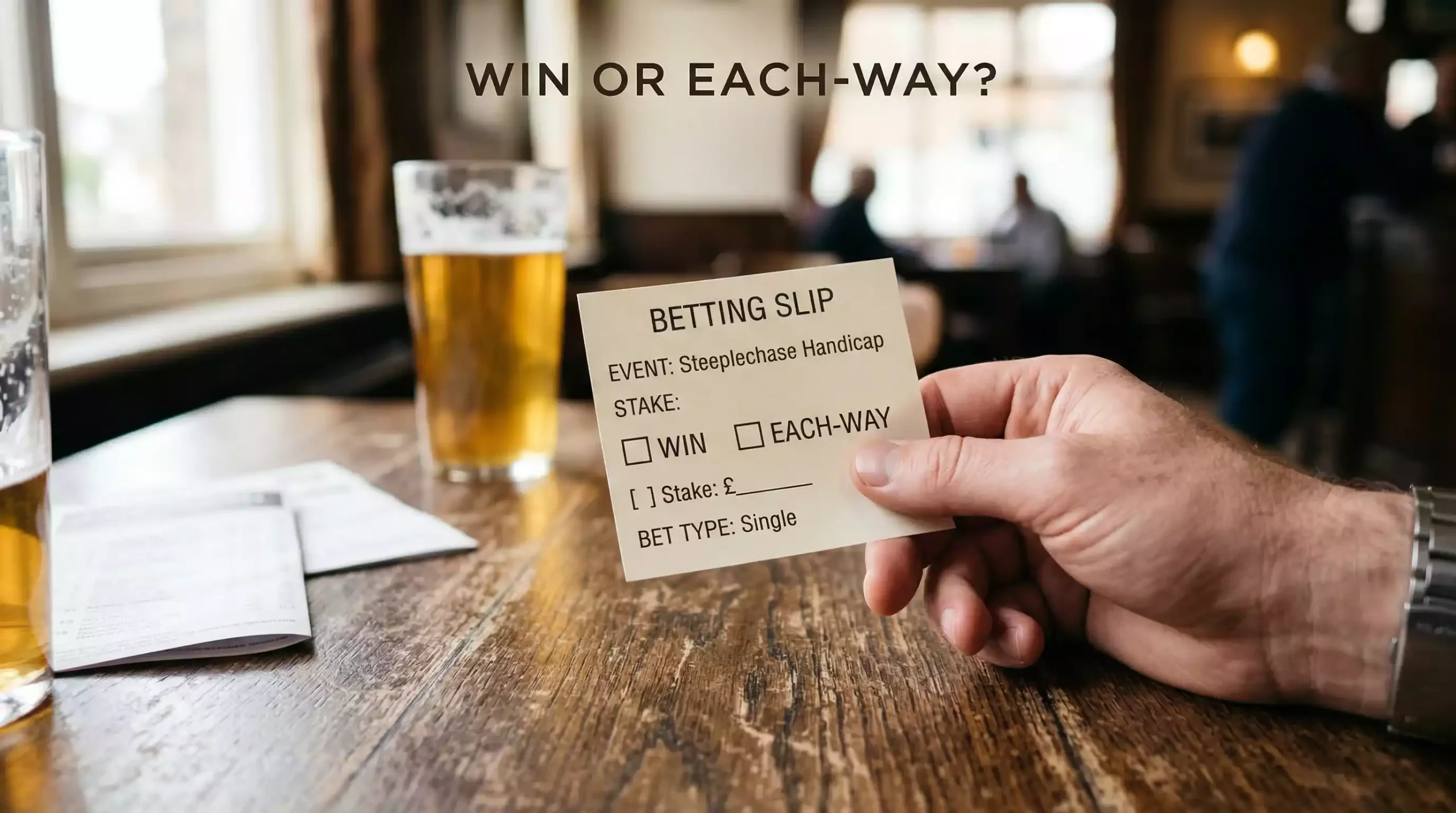
Every April, millions of people who never normally bet on horse racing suddenly need to understand one phrase: each-way. It appears on every betting slip, every app screen, every bookmaker promotion tied to the Grand National. And for most first-time punters, it is the single most confusing element of placing a bet on the race. What Is an Each-Way Bet? Grand National Beginner’s Answer — More on this topic at grand national place a bet.
The confusion is understandable. Each-way is not one bet — it is two, bundled together under a single label. Half on win, half on place. That distinction determines everything about what you get back, how much you risk, and whether the Grand National each-way bet is even the right choice for your particular horse. Once you understand the mechanics, the logic is straightforward. Getting there is the hard part, and that is exactly what this piece addresses.
How an Each-Way Bet Actually Works
An each-way bet splits your total stake into two equal halves. The first half backs your horse to win the race outright. The second half backs it to finish in one of the designated place positions — for the Grand National, typically the first four, though many bookmakers extend this to five, six, or even eight places as a promotional offer.
Because it is two bets, your total outlay doubles. A £5 each-way bet costs £10 in total: £5 on the win, £5 on the place. This is the most common misunderstanding among new bettors, and it catches people out every year. When a bookmaker app asks for your stake and you type £5, ticking the each-way box means you are committing £10, not £5.
The win portion pays at the full advertised odds if your horse crosses the line first. The place portion pays at a fraction of those odds — usually one quarter (1/4) or one fifth (1/5), depending on the bookmaker’s terms for the race. For a 34-runner handicap like the Grand National, the standard industry terms are 1/4 of the odds for the first four places. Enhanced promotions may offer 1/5 odds across more places, which changes the maths considerably.
According to data from the Betting and Gaming Council, more than 80% of all Grand National bets are placed at a stake of £5 or less. That means the vast majority of punters are wagering £10 total on an each-way selection — a modest outlay for a race where outsiders routinely hit the frame and sometimes win outright.
A Worked Example at 12/1
Suppose you place a £10 each-way bet on a horse priced at 12/1. Your total stake is £20: £10 on win, £10 on place.
If the horse wins, you collect on both halves. The win part returns £120 profit plus your £10 stake back, giving you £130 from that half. The place part pays at 1/4 of 12/1, which is 3/1. That yields £30 profit plus your £10 stake, returning £40. Your combined return is £170, of which £150 is pure profit on a £20 outlay.
If the horse finishes second, third, or fourth — placing but not winning — you lose the win half entirely. The £10 win stake is gone. But the place half still pays at 3/1: £30 profit plus your £10 stake, returning £40. Your net result is £40 back on a £20 investment, a £20 profit despite your horse not winning.
If the horse finishes fifth or worse (assuming standard four-place terms), both halves lose. You are down £20. There is no partial refund, no consolation — your horse needed to be in the first four and it was not.
One point that trips people up: the place odds are calculated on the win price you took, not on the starting price. If you backed your horse at 12/1 each-way in the morning and it drifted to 16/1 by the off, your place portion is still based on 12/1 — unless your bookmaker offers Best Odds Guaranteed, in which case the better price applies to both halves. This detail is easy to overlook and can meaningfully affect your return.
The numbers shift dramatically at different price points. At 25/1, the place portion alone at 1/4 odds returns 25/4 — that is 6.25/1. A £10 place stake at those odds returns £72.50 even without a win. At 4/1, the place fraction drops to just 1/1 (evens), barely covering your combined stake. This is why each-way betting suits longer-priced selections far more than short ones. In a race like the Grand National, where the average winning price over the past decade sits around 18.7/1, those fractions tend to be generous.
When You Win, When You Lose, and the Grey Zone
The outcomes of an each-way bet fall into three clear zones. A win triggers both halves: maximum return. A place triggers only the second half: partial return that often still yields a profit. Anything outside the place positions: total loss of stake.
There is a fourth scenario that catches people off guard — the dead heat. If two or more horses cannot be separated for a place position, your place stake is divided by the number of horses involved in the dead heat. A dead heat for fourth in a four-place race means your place stake is halved before the odds are applied. It is rare, but it happens, and it can turn a comfortable profit into a marginal one.
An estimated 13 million adults across the United Kingdom bet on the Grand National each year, according to the Betting and Gaming Council. For the overwhelming majority, each-way is their chosen bet type — and for good reason. The Grand National is a 34-runner handicap over four miles and two and a half furlongs. Anything can happen. Favourites stumble at Becher’s Brook, 33/1 shots stay on their feet, and a horse nobody fancied runs the race of its life to grab fourth. Each-way betting acknowledges that unpredictability and offers a payout even when your selection does not win.
That said, each-way is not always the right choice. If you are backing a heavily fancied runner at 5/1 or shorter, the place fraction (5/4 at quarter odds) barely covers your doubled stake. In those cases, a straight win bet or even a place-only bet can be a sharper use of your money. The value in each-way shines brightest when you are backing a horse at 10/1 or above — exactly the kind of price that the Grand National regularly serves up. See also Grand National Each-Way Places.
The Each-Way Bottom Line
Each-way betting exists because horse racing, and the Grand National in particular, is fundamentally uncertain. It converts a single wager into a safety net: you are covered if your horse wins, and you still collect if it merely finishes in the places. The cost is a doubled stake. The benefit is a dramatically wider range of profitable outcomes. For a once-a-year punter backing a horse at double-digit odds in the world’s most unpredictable steeplechase, that tradeoff usually makes sense.
