Best Odds Guaranteed is one of those betting features that costs you nothing and occasionally hands you a windfall. If you take a price on a Grand National runner in the morning and the starting price drifts to something bigger by the time the race begins, BOG ensures you are paid at the higher figure. You locked in your selection early, but you get the benefit of any late market movement in your favour. The reverse does not apply — if the price shortens, you keep your original, bigger odds.
For a race like the Grand National, where odds can shift substantially in the final hours before the off, BOG removes the anxiety of timing your bet. It is a one-way valve: it can only improve your payout, never reduce it.
How Best Odds Guaranteed Works in Practice
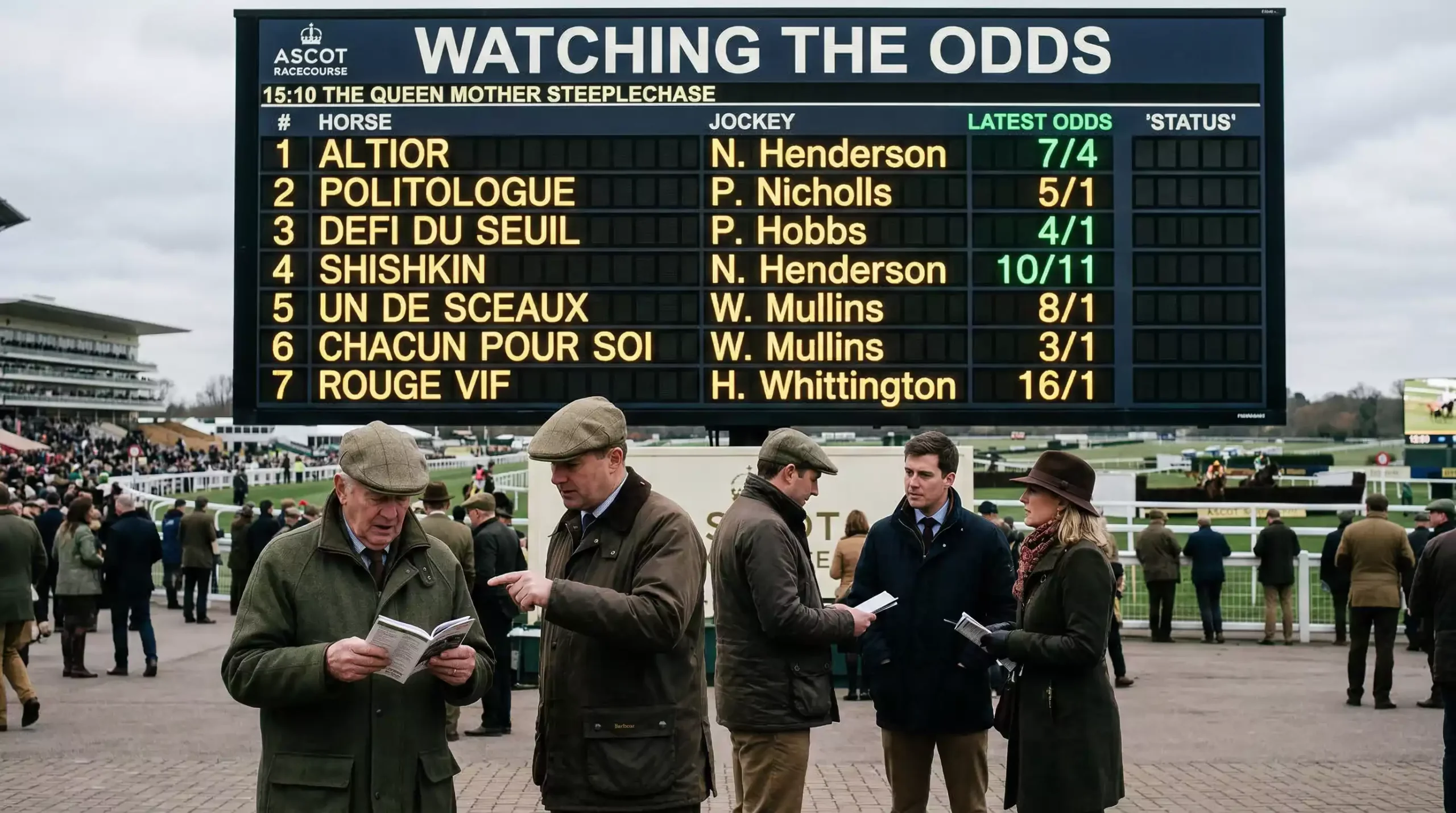
The mechanics of BOG are simple. You place a bet at whatever price is available when you make your selection — say, 16/1 on a horse at 9am on Grand National morning. Over the course of the day, money flows into the market, jockey bookings are confirmed, paddock reports circulate, and the going is officially announced. All of these factors move the odds. If your horse drifts to 20/1 by the time the race starts at 4pm, your bet is settled at 20/1 rather than 16/1. Your £10 each-way bet now pays as though you took the bigger price.
If, on the other hand, your horse shortens to 12/1 because it attracts heavy support, you are still paid at your original 16/1. The bookmaker has guaranteed that you receive the best of both prices — the one you took and the starting price. Hence the name.
BOG typically applies only to bets placed on the day of the race, not to ante-post bets taken weeks or months in advance. The precise activation rules vary by bookmaker. Some apply BOG to all UK and Irish racing automatically. Others restrict it to bets placed within a certain timeframe — for example, from 8am on race day onwards. A handful of operators limit the maximum additional payout generated by BOG, capping the extra winnings at a set figure. These details matter, and they are worth checking before you place your bet, because a BOG that is capped at £500 additional payout behaves very differently from one with no cap.
A BOG Example That Shows Why It Matters
Consider the following scenario. You back a horse at 14/1 each-way at 10am on Grand National morning. Total stake: £20 (£10 win, £10 place at 1/4 odds). By post time, the horse has drifted to 20/1 — perhaps because money has gone elsewhere, or simply because the market has recalibrated based on the declared going.
Without BOG, your bet would be settled at 14/1 regardless. The win part returns £140 profit plus stake if it wins. With BOG, the bet is settled at 20/1: £200 profit plus stake on the win part, and 5/1 on the place part instead of 3.5/1. On a winning each-way bet, that BOG upgrade is worth an extra £75 — money that arrives in your account without you having done anything differently. You just happened to place your bet with a bookmaker that offers the guarantee.
The value of BOG is asymmetric and it correlates with volatility. In a stable market where prices barely move, BOG makes little practical difference. In a volatile market — which the Grand National almost always produces, given the last-minute withdrawals, going changes, and sheer weight of public money — BOG can meaningfully increase your returns. The Gambling Commission’s industry statistics for the 2023/24 financial year showed that remote horse racing GGY reached £733.5 million after corrections, with bookmaker margins widening even as turnover declined. In an era of tighter pricing, BOG is one of the few mechanisms that consistently works in the punter’s favour.
Who Offers BOG on the Grand National
Most major UK-licensed bookmakers offer Best Odds Guaranteed on the Grand National as part of their standard horse racing proposition. It is so widely available that its absence is more notable than its presence. If a bookmaker does not offer BOG on the biggest race of the year, that is a signal worth heeding.
The trend in the UK betting market, however, has been towards the selective withdrawal of punter-friendly concessions. The number of licensed betting premises across Great Britain has fallen to 5,825 — a decline of 36% over the past decade, according to the Gambling Commission’s 2024/25 annual report. Online operators face their own margin pressures, and several have periodically restricted or removed BOG on certain races or for certain customer segments. The Grand National, given its public profile, is one of the last races where BOG withdrawal would generate significant backlash, so it remains broadly available. But checking is never wasted effort.
When comparing BOG terms across bookmakers, the key variables are: does BOG apply automatically or require opt-in? Is there a maximum stake or maximum payout enhancement? Does it apply to each-way bets or only win bets? Is it available on mobile and desktop, or only one platform? Answering these questions takes less than a minute per operator and can directly affect what you collect if your horse wins or places at a bigger starting price.
When BOG Matters Most
BOG is most valuable in two specific scenarios. The first is when you identify a horse early on race morning that you believe will drift — perhaps because it is currently too short based on name recognition rather than form, or because the going is expected to change in a direction that benefits other runners. Placing your bet early locks in the current price as a floor, while BOG ensures you capture any upward movement.
The second scenario is when you simply do not have time to monitor the market throughout the day. Many Grand National punters are exactly this type: they place a bet in the morning, go about their Saturday, and tune in for the race at 4pm. Without BOG, those punters are locked into whatever price they took at 9am. With BOG, they are automatically upgraded to the best available price, no further action required.
Alan Delmonte, Chief Executive of the Horserace Betting Levy Board, has noted that betting turnover on British racing has fallen by around 20% in two years, driven in part by the impact of financial checks on higher-staking customers. As margins tighten and operators look for ways to maintain profitability, promotional concessions like BOG face ongoing commercial pressure. For the 2026 Grand National, it remains widely available. Whether it stays that way in future years depends on the broader regulatory and commercial environment. The practical takeaway for this year is simple: BOG is free, it can only help you, and you should ensure your chosen bookmaker offers it before placing your Grand National bet.