
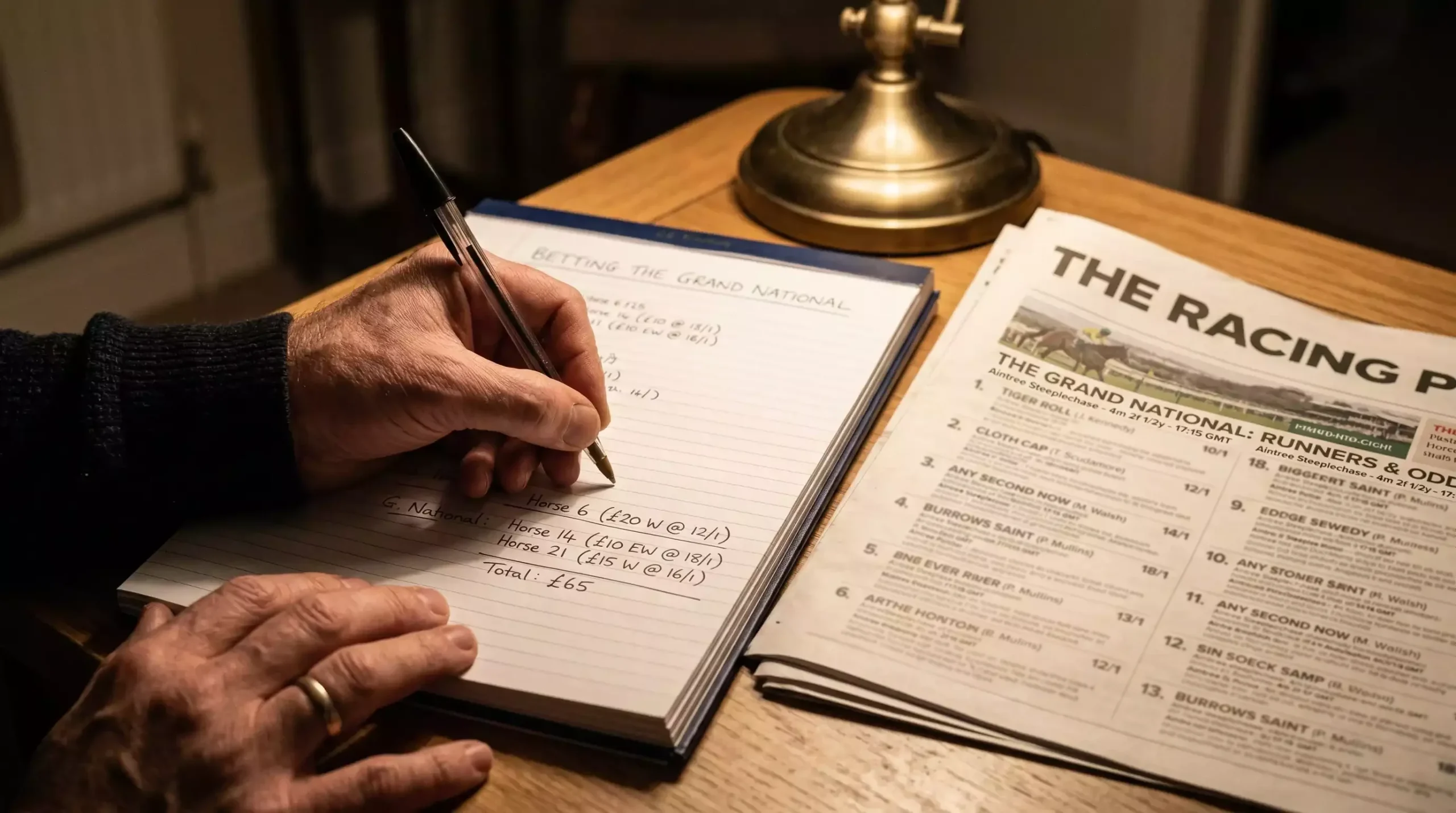
A Grand National bet calculator does one useful thing: it removes the guesswork from what you will actually receive if your horse wins or places. The each-way bet structure — two bets, two different payout rates, one combined return — is simple in concept but surprisingly easy to miscalculate in practice. Getting the maths right before you bet is better than getting a surprise afterwards, and the arithmetic involved requires nothing more than multiplication and addition.
This is the manual version of what any online calculator does automatically. Understanding the formula means you can sense-check the numbers on your betting slip, compare returns across different odds and place terms, and make an informed decision about whether each-way is the right structure for your Grand National selection.
The Each-Way Formula
Every each-way bet consists of two separate calculations that are then combined.
The win part is straightforward: multiply your win stake by the odds, then add the stake back. If you bet £10 at 16/1, the win return is (£10 x 16) + £10 = £170. That is your total return if the horse wins — £160 profit plus your £10 stake.
The place part requires one extra step. First, calculate the place odds by dividing the win odds by the place fraction. For a race with standard 1/4 place terms, 16/1 becomes 4/1 (16 divided by 4). Then apply the same formula: multiply your place stake by the place odds, then add the stake back. A £10 place stake at 4/1 returns (£10 x 4) + £10 = £50.
Your total each-way return if the horse wins is both halves combined: £170 + £50 = £220. Your total stake was £20 (£10 win + £10 place), so your profit is £200.
If the horse places but does not win, you lose the win stake entirely. The return is the place part only: £50. Your total stake was £20, so your profit is £30.
That is the entire formula. Win return = (stake x odds) + stake. Place return = (stake x (odds / fraction)) + stake. Total return = win return + place return if the horse wins, or just place return if it places.
Example: Your Horse Wins at 20/1
The majority of Grand National bets are placed at modest stakes. Data from the Betting and Gaming Council shows that over 80% of wagers on the race are at £5 or less. So let us use a £5 each-way bet — £10 total — on a horse at 20/1 with standard 1/4 place terms.
Win part: (£5 x 20) + £5 = £105.
Place part: place odds are 20/1 divided by 4 = 5/1. Place return: (£5 x 5) + £5 = £30.
Total return if the horse wins: £105 + £30 = £135. Your total outlay was £10, so profit is £125.
Now compare the same bet with 1/5 place terms instead of 1/4. The place odds become 20/1 divided by 5 = 4/1. Place return: (£5 x 4) + £5 = £25. Total return if the horse wins: £105 + £25 = £130. The difference is £5 — not trivial on a £10 total stake, and it illustrates why checking whether your bookmaker offers 1/4 or 1/5 place terms is worth the thirty seconds it takes.
The gap between 1/4 and 1/5 terms widens at higher odds. At 33/1, the place portion at 1/4 is 33/4 = 8.25/1, returning £46.25 on a £5 stake. At 1/5, it is 33/5 = 6.6/1, returning £38. That is an £8.25 difference on a single £5 each-way bet — enough to matter when your horse finishes third and the place portion is your only return.
Example: Your Horse Places but Does Not Win
This is the scenario that makes each-way betting worthwhile for the Grand National. Your horse does not cross the line first, but it finishes in one of the designated place positions. The win half of your bet is lost. Only the place half pays.
Using the same £5 each-way at 20/1 with 1/4 terms: place return is £30. You staked £10 total (£5 win + £5 place), so your net profit is £20. Your horse did not win the Grand National and you still made double your money.
At shorter odds, the maths is less forgiving. A £5 each-way at 6/1 with 1/4 terms: place odds are 6/4 = 1.5/1. Place return: (£5 x 1.5) + £5 = £12.50. Total outlay was £10. Net profit: £2.50. Barely worth celebrating. This is why the each-way structure suits the Grand National’s typically long-priced field better than a race where the favourite is 2/1.
Remote horse racing betting generated £766.7 million in gross gambling yield for UK operators in the 2024/25 financial year. The Grand National contributes a disproportionate share of that on a single raceday, and the each-way bet is the engine driving most of it. Knowing what your each-way bet returns at any given price point is not optional homework — it is the baseline for making a decision that matches your expectations.
The Dead Heat Rule
Dead heats are rare in the Grand National but not impossible, particularly for the final place position. If two horses cannot be separated by the judge for the fourth finishing position in a four-place market, a dead heat is declared and the dead heat rule applies.
Under the dead heat rule, your stake on the affected part of the bet is divided by the number of horses involved in the dead heat before the odds are calculated. If your horse is involved in a dead heat for fourth with one other runner, your £5 place stake is halved to £2.50. The place odds are then applied to £2.50 instead of £5.
At 20/1 with 1/4 terms: normal place return would be £30. Dead heat place return: (£2.50 x 5) + £2.50 = £15. You also receive the unused half of your place stake back: £2.50. So your total place return is £15 + £2.50 = £17.50, compared to £30 without the dead heat. The difference is meaningful — a dead heat for the last qualifying place approximately halves your place payout.
Dead heats for win positions follow the same rule but affect the win part of the bet instead. These are even rarer in steeplechases, where the finishing distances are usually measured in lengths rather than noses. In twenty years of Grand Nationals, a dead heat for first has not occurred. But the rule exists, and if your each-way bet is large enough for precision to matter, factoring in the possibility is prudent rather than paranoid.