 Available in US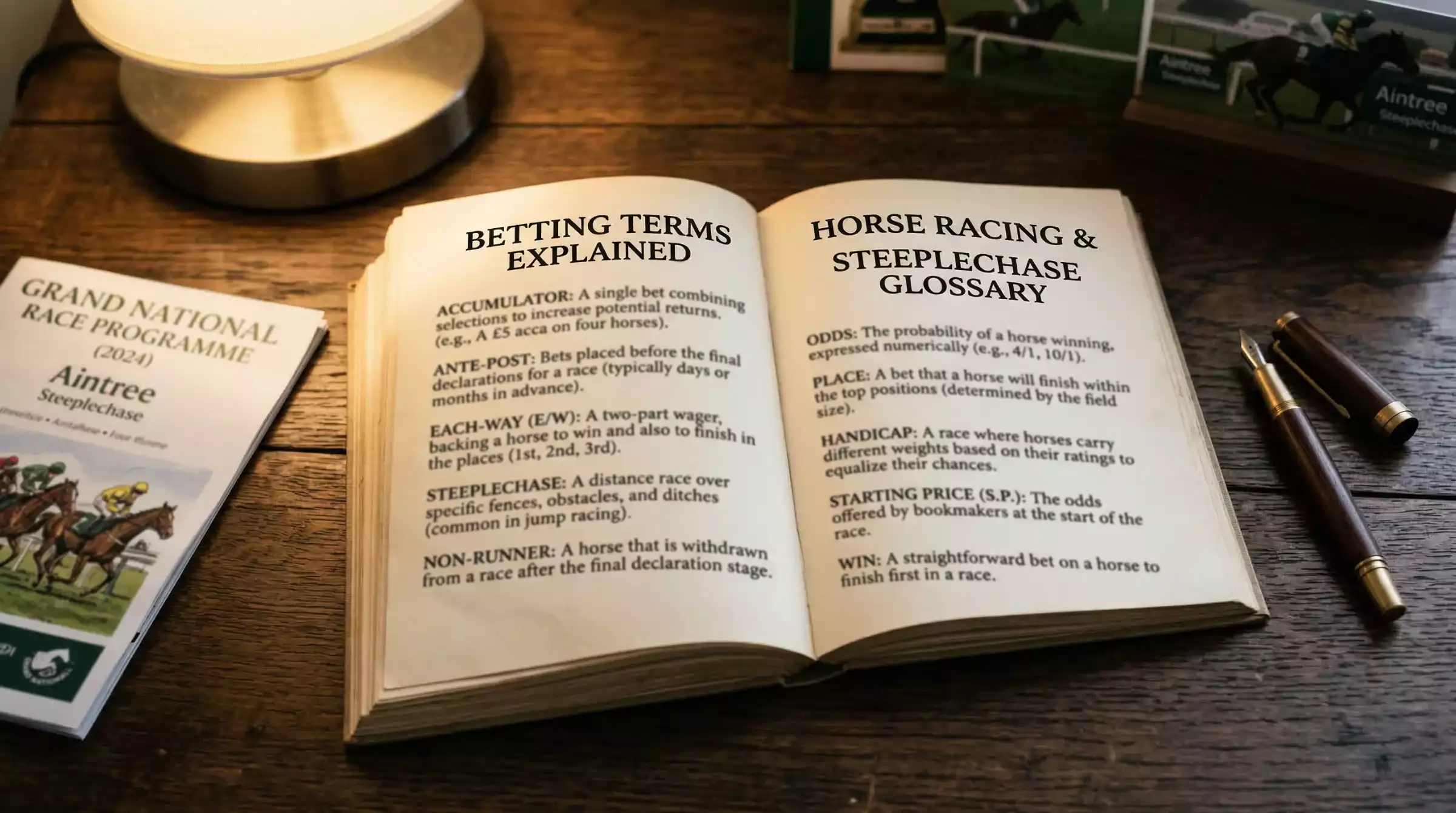
Horse racing has its own language, and the Grand National adds a few terms of its own. If you have ever stared at a betting slip wondering what each-way means, what NRNB stands for, or why someone mentioned the overround, this glossary covers everything you are likely to encounter between deciding to have a flutter and collecting — or not collecting — your winnings. Grand National Betting Glossary — More on this topic at grand national place a bet.
Every term, one place. Alphabetical, plain English, no jargon used to explain jargon.
A to E
Accumulator (Acca): A single bet combining two or more selections across different races. All selections must win for the bet to pay out. The odds of each selection are multiplied together, producing a combined price that is much larger — and much harder to land — than any individual leg.
Ante-Post: A bet placed before the day of the race, often weeks or months in advance. Ante-post odds are typically larger than race-day prices because you accept the risk that your horse may not run. If the horse is withdrawn, your stake is lost under standard ante-post rules.
Best Odds Guaranteed (BOG): A bookmaker promotion that ensures you receive the higher of two prices: the odds you took when you placed your bet, or the starting price at the off. BOG can only improve your payout, never reduce it. Most major UK bookmakers offer it on the Grand National.
Brought Down: A horse that falls because of interference from another horse — typically a faller landing in its path. A brought-down horse did not make a jumping error itself. Some faller refund promotions cover brought-down horses; others do not.
Cash Out: A feature that allows you to settle your bet before the race finishes. The cash-out value is calculated in real time based on the current probability of your horse winning. Available on most online betting apps but not on paper betting slips.
Dead Heat: When two or more horses cannot be separated by the judge for a finishing position. Under dead heat rules, your stake on the affected part of the bet is divided by the number of horses involved before the odds are applied.
Drift: When a horse’s odds lengthen — become bigger — indicating that less money is being placed on it relative to the rest of the field. A horse drifting from 10/1 to 14/1 is becoming less fancied by the market.
Each-Way (E/W): Two bets in one: a win bet and a place bet at the same stake. If the horse wins, both halves pay. If it places (finishes in the designated positions), only the place half pays at a fraction of the win odds. An each-way bet doubles your total stake.
Exacta: A Tote pool bet requiring you to pick the first two finishers in exact order. The payout is a pool dividend calculated after the race.
F to N
Faller: A horse that falls during the race. Some bookmakers offer refunds (as free bets) if your selection falls at any fence during the Grand National.
Forecast: A fixed-odds bet requiring you to name the first two finishers in exact order (straight forecast) or in either order (reverse forecast). A reverse forecast costs double the stake because it covers two permutations.
Form: A horse’s recent racing record, displayed as a sequence of finishing positions. For example, 1-3-2-F means the horse won, then finished third, then second, then fell. The most recent result is on the right. Form is the primary tool for assessing a horse’s current ability and fitness.
Going: The official description of ground conditions at the racecourse, ranging from Hard (fastest) through Firm, Good to Firm, Good, Good to Soft, Soft, and Heavy (slowest). The going is measured by a penetrometer and announced in the days before the race. It significantly affects which horses are suited to the conditions.
Gross Gambling Yield (GGY): The revenue retained by a betting operator after paying out winnings — essentially, stakes minus payouts. The UK gambling industry generated £16.8 billion in GGY during the 2024/25 financial year, with remote horse racing betting contributing £766.7 million of that total.
Handicap: A race in which horses carry different weights to equalise their chances. The Grand National is a handicap: the best horse carries the most weight, the weakest carries the least. The weights are set by the official handicapper based on each horse’s rating.
Levy (Horserace Betting Levy): A statutory charge of 10% on bookmakers’ GGY from British horse racing, collected by the Horserace Betting Levy Board. The levy yielded £109 million in the 2024/25 financial year and funds prize money, horse welfare, and veterinary research.
Non-Runner No Bet (NRNB): A promotion offered by most bookmakers on the Grand National. If your horse is withdrawn before the race, your stake is refunded in full. NRNB eliminates the main risk of ante-post betting.
O to Z
Official Rating (OR): A numerical assessment of a horse’s ability, assigned by the BHA handicapper. Higher ratings indicate better horses. In the Grand National, the top-rated horse carries the heaviest weight. Ratings typically range from 130 to 170 for Grand National runners.
Overround: The margin built into a bookmaker’s prices that ensures the combined implied probabilities of all possible outcomes exceed 100%. It is how bookmakers guarantee a profit regardless of the result. A market with a 120% overround means the bookmaker expects to retain roughly 20% of the stakes placed — though individual bet outcomes vary.
Place: A finishing position that qualifies for a payout under each-way terms. For the Grand National, the standard place terms cover the first four finishers. Many bookmakers extend this to five, six, or more as a promotional offer.
Placepot: A Tote pool bet requiring you to pick a placed horse in each of the first six races on the card. If all six place, you share the pool. Permutation betting is available to cover multiple selections in each race.
Pulled Up: A horse that is stopped by its jockey during the race, usually because it is too tired or has made too many jumping errors to continue safely. A pulled-up horse has not fallen and is typically not covered by faller refund promotions.
Rule 4: A deduction applied to winning bets when a horse is withdrawn from a race after the final declarations but before the race starts. The deduction compensates for the removal of a runner from the market. Rule 4 applies on race day only, not to ante-post bets.
Starting Price (SP): The official odds of a horse at the moment the race begins. The SP is determined by on-course bookmakers and is used to settle bets where no fixed price was taken.
Steam: When a horse’s odds shorten rapidly, indicating heavy betting support. A horse that steams from 20/1 to 12/1 is attracting significant money, often interpreted as a sign of informed confidence.
Tote: A pool betting operator where all stakes on a given outcome are pooled together and the payout is calculated after the race by dividing the pool among winning tickets. The Tote operates both on-course and online.
Tricast: A bet requiring you to name the first three finishers in exact order. The payouts can be very large in a field of 34 runners, but the difficulty of predicting three specific outcomes in sequence makes this a high-risk, high-reward wager.
Unseated Rider: When a jockey is dislodged from the horse during the race, typically at a fence. The horse may continue as a loose runner. Unseated riders are usually covered by faller refund promotions.
Win Bet: The simplest bet type: you back a horse to finish first. If it wins, you are paid at the advertised odds plus your stake. If it finishes anywhere else, you lose your stake. See also Latest Betting News & Sports Betting Updates.
