
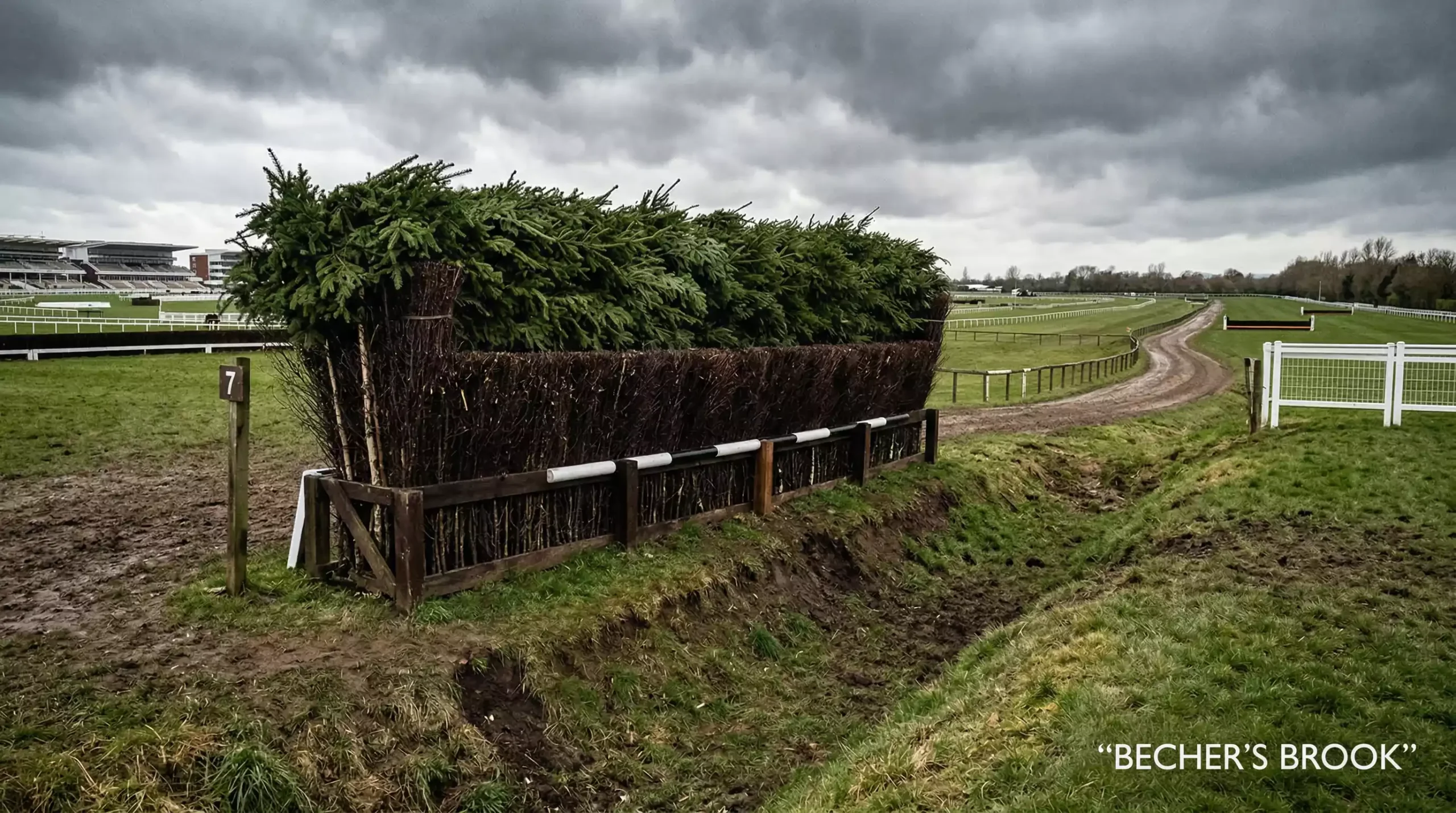
The Grand National course at Aintree contains 16 unique fences, 14 of which are jumped twice during the race’s two laps. That makes 30 jumping efforts across four miles and two furlongs — more than any other race in the British calendar. Each fence has its own character, its own history, and its own reputation for sorting the competent from the chaotic. For punters, the course is not scenery. It is data.
You do not need to walk the course to use this information. You need to know which fences cause the most problems, what kind of horse handles them, and how the layout rewards certain running styles over others.
How the Grand National Course Is Laid Out
The Grand National track is a distinct circuit at Aintree, separate from the Mildmay course used for other races during the festival. Runners start near the grandstand, head away from the crowd, and negotiate the famous fences in a roughly triangular pattern before returning. The first circuit covers all 16 fences. The second covers the first 14 again — runners bypass The Chair and the Water Jump on the final lap, bearing right after the 30th fence onto a run-in of 494 yards to the finishing post.
That run-in is not straight. An elbow — a slight right-hand turn — forces jockeys to adjust their line before the final stretch. Horses that are tiring badly often drift wide here, losing lengths they cannot recover. The run-in has decided more Grand Nationals than most people realise. Crisp in 1973, carrying top weight and fifteen lengths clear at the last, was caught by Red Rum. Devon Loch in 1956 collapsed inexplicably with the race at his mercy.
The race carries a £1 million prize fund — the most valuable steeplechase in Europe. That financial weight adds competitive intensity to every fence. Horses are not merely jumping obstacles; they are jumping them under pressure, in a large field, at sustained pace, with fatigue accumulating from the first mile onwards.
The Fences That Matter Most
Becher’s Brook, the sixth fence on the first circuit and the 22nd on the second, is the most famous obstacle in steeplechasing. It stands five feet high, which is not exceptional. What makes it notorious is the landing side: the ground drops away between six and ten inches below the takeoff side. A horse that jumps too steeply or meets the fence wrong pitches forward on landing, with momentum carrying it downhill. The fence has been modified several times, but it remains the defining test of the first circuit.
The Chair, the 15th fence, is the tallest on the course at five feet two inches, preceded by a six-foot open ditch. It is jumped only once, on the first circuit, directly in front of the grandstand. The combination of height, ditch, and crowd noise makes it formidable, though the single jumping effort means it accumulates fewer total fallers than fences jumped twice.
The Canal Turn, fence seven on the first circuit and 23rd on the second, requires horses to turn sharply left immediately after landing. Horses that jump it too fast or too straight end up running wide. Experienced Grand National runners learn to angle their jump, landing on a trajectory that carries them into the turn. First-timers do not have that advantage.
Valentine’s Brook, the ninth and 25th fence, features a pronounced drop on the landing side. The first-circuit effort is often jumped well. The second-circuit effort, with fatigue setting in, is where Valentine’s claims its victims.
The first fence deserves mention for a different reason. It is not particularly big or technically demanding, but it is where the field is most tightly packed. Thirty-four horses jumping a fence together creates its own hazard: crowding, loose horses, and chain reactions where one faller brings down a neighbour.
What the Faller Data Tells Punters
Faller statistics by fence are published after each Grand National. The pattern is consistent: Becher’s Brook on the second circuit produces the most fallers relative to the number of horses that reach it, followed by the Canal Turn and Valentine’s on the second circuit. The first fence produces the highest absolute number of fallers because the entire field attempts it, but proportionally it is less lethal than the later obstacles.
The second-circuit data matters more for a practical reason: any horse that reaches the second circuit is still in the race and still carrying your money. A fall at the 22nd fence, when your horse is travelling well and you are starting to believe, costs more emotionally and financially than a fall at the first. The distinction also affects betting strategy: faller refund promotions, offered by most major bookmakers, return your stake if your horse falls. But those promotions cannot return the emotional investment of watching your selection lead the Grand National for three miles before crumpling at Becher’s on the second circuit.
The reduction of the maximum field from 40 to 34 runners, implemented from 2024, has had a measurable effect on first-fence faller rates. Fewer horses jumping together means less crowding, fewer chain reactions, and a marginally cleaner passage through the opening obstacles. The later fences, where fatigue rather than crowding is the primary cause of falls, have not been meaningfully affected by the field-size reduction.
Over 5 million people attended British racecourses in 2025 according to the BHA’s annual report, and a significant portion of those attend the Aintree Festival. The fences are the reason the Grand National is the Grand National. For punters, they are also the reason why horses with clean jumping records — few falls, few unseated riders across their career — have a measurable edge. A horse’s completion rate across its career, particularly at courses with demanding fences, is one of the most underused selection filters in Grand National betting.
Using Fence Data in Your Selection
When narrowing your Grand National shortlist, look for two things: experience over the National fences, and a career jumping profile that suggests reliability.
Previous runs in the Topham Chase, which is run over the National fences at a shorter distance on the Friday of the Aintree Festival, provide the most direct course evidence. A horse that has completed the Topham cleanly has seen Becher’s Brook from the takeoff side, navigated the Canal Turn, and landed safely over Valentine’s. No amount of ability compensates for the shock of encountering these obstacles for the first time in a field of 34 at racing pace.
Where no Aintree experience exists, look for evidence of bold, efficient jumping at comparable courses — Haydock, Warwick, and Sandown all feature demanding fences that reward similar skills. A horse that consistently jumps well at these tracks is more likely to handle Aintree than one whose best form comes on easier, flatter courses. The course decides the race. Your job is to find the horse best equipped to survive it.