
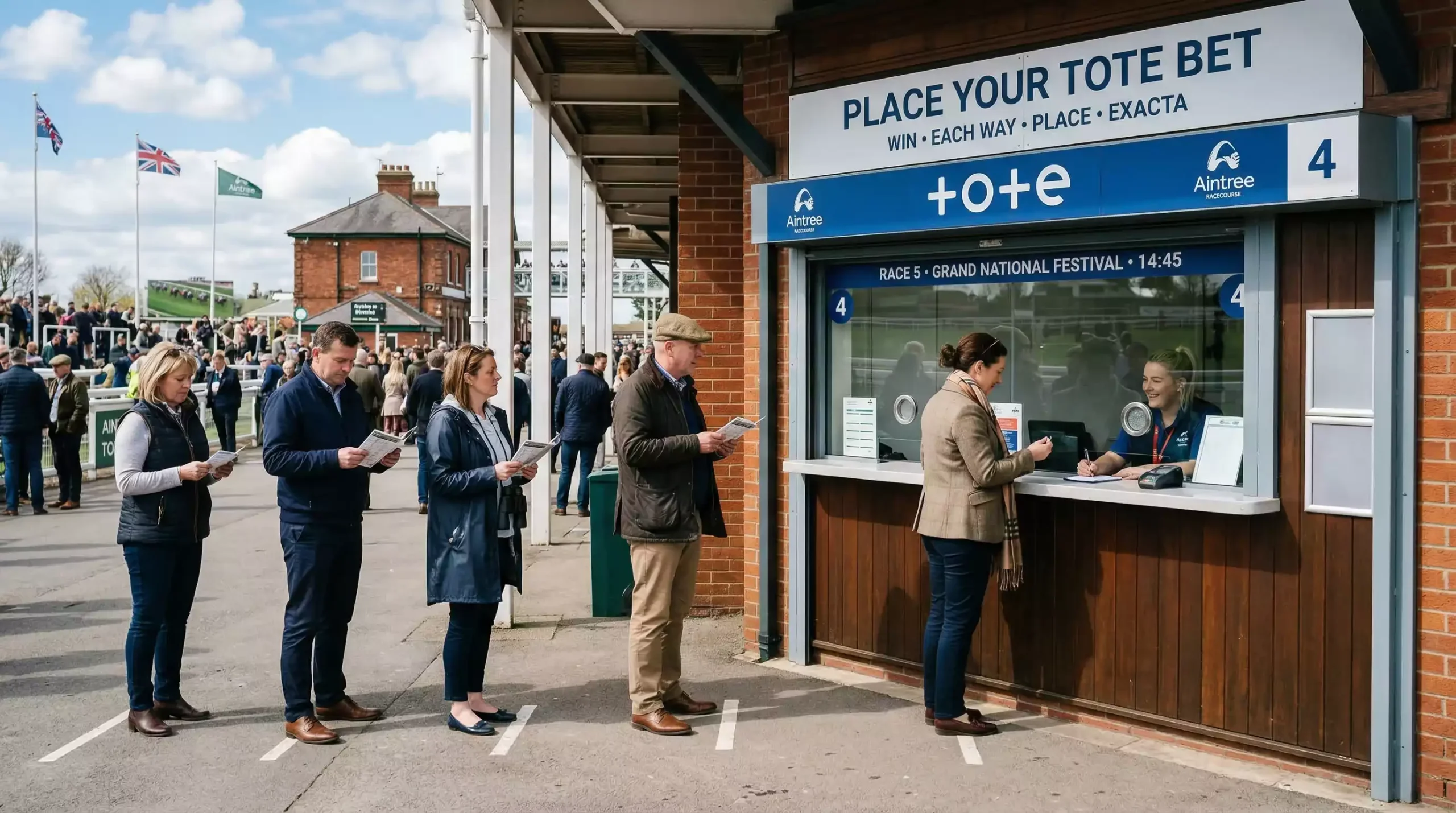
Tote betting on the Grand National works on a fundamentally different principle from fixed-odds betting with a bookmaker. When you bet with the Tote, your stake goes into a shared pool. After the race, the pool is divided among all winning ticket holders. You do not know your payout when you place the bet — it depends on how much money went into the pool and how many people backed the same outcome. Pool money, shared prizes. It is closer to a lottery than a traditional bookmaker wager, and for certain bet types it offers payouts that fixed-odds operators cannot match.
The Tote operates at every British racecourse and online, with a minimum bet of just £2 — lower than most bookmaker minimums. For Grand National day, when millions are placing bets of modest size, the Tote’s accessibility and its unique pool-based bet types make it a distinct alternative to conventional bookmaker betting.
Totewin and Toteplace
The two simplest Tote bets mirror the two simplest bookmaker bets. Totewin asks you to pick the winner of the race. Your stake enters the win pool, and if your horse wins, you receive a share of the total pool proportional to the amount bet on your selection. A less popular winner means fewer winning tickets and a bigger payout per ticket — which is why Tote win dividends on outsiders can occasionally exceed the fixed-odds starting price.
Toteplace asks you to pick a horse to finish in one of the designated places. For the Grand National, the standard Tote place terms cover the first four finishers, though this can be extended for promotional purposes. The place pool works the same way as the win pool: all place stakes are pooled, and winners share the pot. Because more horses qualify for a place than for a win, the pool is divided more ways and the individual dividends are smaller — but the probability of collecting is higher.
A Tote each-way bet combines both: half your stake goes into the win pool, half into the place pool. The mechanics are identical to a bookmaker each-way, but the payouts are determined by pool division rather than fixed odds. This means you cannot calculate your exact return in advance — a feature that some punters find frustrating and others find exciting, since it introduces an element of genuine surprise when the dividends are declared.
Exacta and Trifecta
The Exacta requires you to predict the first two finishers in the correct order. All Exacta stakes form a single pool, and if you name the correct combination, you share the pool with anyone else who did the same. In a 34-runner race where the first two home could be any combination of horses at prices from 6/1 to 100/1, the Exacta pool frequently delivers dividends in the hundreds or thousands of pounds from modest stakes.
On-course betting on horse racing in Great Britain has changed dramatically over the past two decades. Data from a parliamentary sectoral analysis showed that on-course GGY declined from £24 million in 2009/10 to £20.6 million by 2016, with the shift to online betting accounting for much of the loss. The Tote’s Exacta and Trifecta pools have partly resisted this decline because they offer something online bookmakers struggle to replicate: genuinely unpredictable payouts that scale with pool size, and Grand National day builds one of the biggest Tote pools of the year.
The Trifecta extends the Exacta logic to three horses: first, second, and third in exact order. The difficulty is extreme, the potential payout enormous. Grand National Trifecta dividends routinely run into four figures from a £1 unit stake, and in particularly open renewals they can reach five figures. A combination Trifecta, where you select three or more horses to fill the first three places in any order, covers all permutations at the cost of more units — six units for three horses, sixty for five — but brings the probability of collecting into a more realistic range.
Swinger and Permutation Bets
The Swinger is uniquely Tote — no fixed-odds equivalent exists at most bookmakers. You select two horses to finish in the first three, in any order. Your horses can be first and second, first and third, or second and third. As long as both appear somewhere in the first three finishers, you win. The Swinger is more forgiving than an Exacta because neither the order nor the specific positions matter — only that both horses make the top three.
Permutation betting on the Tote allows you to select more than the minimum number of horses in pool bets like the Placepot, Exacta, or Trifecta. Instead of picking one horse per slot, you pick several, and the Tote generates all possible combinations. The cost is one unit stake per combination. Three selections in an Exacta produces six permutations (each pair in each order). Four selections in a Trifecta produces 24 permutations. The maths multiplies quickly, so keeping your permutation selections tight is essential for managing the total outlay.
The Placepot is the Tote’s signature pool bet and one of the most popular wagers at any British race meeting. It requires you to select a horse to place in each of the first six races on the card — not just the Grand National. Because the Aintree Festival card features multiple competitive races before the main event, building a successful Placepot requires opinions across the entire afternoon. The pool is usually one of the largest of the year on Grand National day, which means the dividend can be substantial even if many people collect.
Understanding Pool Returns
The Tote declares its dividends after each race, expressed as a return per £1 unit stake. A Totewin dividend of £18.40 means a £1 win bet returns £18.40 in total (£17.40 profit plus the stake). A £2 bet at the same dividend returns £36.80.
Tote dividends are not directly comparable to bookmaker starting prices, though they often end up in a similar range. On popular runners, the Tote dividend is usually similar to or slightly lower than the SP, because a lot of money flows to the same horse. On less popular runners, the Tote dividend can significantly exceed the SP — sometimes dramatically — because fewer people backed that outcome and the pool division is more generous.
The Grand National’s economic impact extends well beyond the betting ring: a 2023 study by Liverpool Business School estimated that the 2022 Grand National generated over £60 million for the local economy. The Tote pools contribute to that ecosystem directly, since a portion of Tote revenue flows back to the racecourse. Betting with the Tote on Grand National day is, in a small but tangible way, supporting the event and the venue that hosts it.
For the casual Grand National punter, the Tote’s appeal is twofold. First, the low minimum stake of £2 makes it accessible. Second, the pool-based payouts mean you are not competing against a bookmaker’s margin — you are sharing a pot with other bettors, and the Tote’s commission (deducted before dividends are calculated) is transparent and standardised. The tradeoff is uncertainty: you do not know what you will win until after the race. For a once-a-year bet on a race where uncertainty is the entire point, that feels appropriate.