- Why Strategy Matters Even for a Once-a-Year Bet
- Step One: Set a Budget You're Comfortable Losing
- The 80/20 Rule: Balancing Safe and Speculative Bets
- Fixed Stake vs Percentage Stake: Two Approaches
- Dutching the Grand National: Backing Multiple Horses
- Using Free Bets, Price Boosts, and Refunds as Tools
- When Cash Out Makes Sense — and When It Doesn't
- After the Race: Withdrawals, Taxes, and Next Steps
Why Strategy Matters Even for a Once-a-Year Bet
Most people who bet on the Grand National do it once a year. They pick a horse, place a fiver each-way, and either collect or do not. The total at risk is small, the entertainment value is high, and the idea that this simple annual flutter needs a “strategy” might seem like overcomplicating something that should be fun.
But strategy is not about complication. It is about making better decisions with the money you have already decided to spend. The same budget, deployed thoughtfully, can produce a materially better outcome than the same budget deployed on impulse. Not every time — this is horse racing, and specifically the Grand National, where 34 horses are jumping 30 fences and the universe of possible outcomes is vast — but often enough to make the planning worthwhile.
The data supports this. According to industry figures compiled by the Betting and Gaming Council, over 80% of Grand National bets are placed at stakes of £5 or less. Around 30% of people who bet on the race are depositing for the first time or for the first time in a year. This is a market overwhelmingly composed of casual participants with modest budgets. A few minutes of planning — setting a budget, choosing between bet types, shopping for the best price — is the difference between a considered punt and an expensive impulse. Protect your bankroll, and the racing takes care of itself.
What follows is not a system for beating the bookmakers. There is no such system for a 34-runner steeplechase. It is a framework for deploying your Grand National budget in a way that gives you the best chance of collecting something, minimises avoidable waste, and — most importantly — ensures that the amount you spend is the amount you planned to spend, not a penny more. That is what strategy means in this context: a plan made before the excitement starts, and the discipline to follow it once it does.
Step One: Set a Budget You’re Comfortable Losing
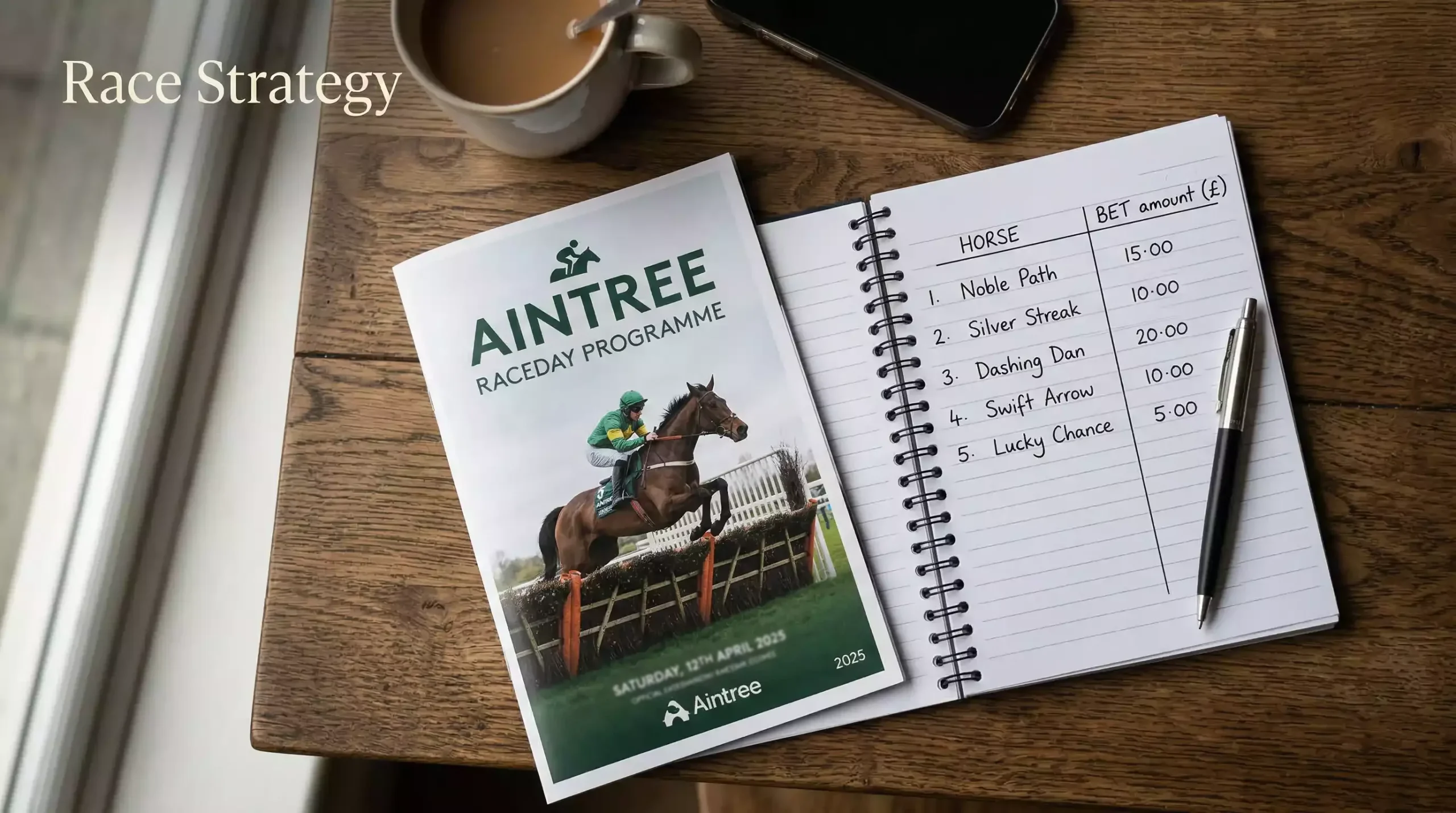
Before you look at a single horse, a single set of odds, or a single bookmaker promotion, decide how much money you are willing to spend on the Grand National. Not how much you hope to win. How much you are comfortable losing. Because the most likely outcome for any individual bet on a 34-runner steeplechase is that you lose your stake. That is not pessimism. It is probability.
The budget should be an amount that, if lost entirely, would not affect your week. For most casual Grand National punters, that is somewhere between £5 and £50. If it is £10, your entire Grand National strategy operates within £10. If it is £30, you have more options — multiple bets, different bet types, a split between a main selection and a speculative flutter — but the ceiling is still £30. Setting the budget first prevents the most common mistake in recreational betting: chasing. A bad result on the first bet leads to a second bet to recover the loss, which leads to a third, and by the time the Grand National starts you have spent more than you intended on races you did not plan to bet on.
Write the number down if it helps. Put it in your phone’s notes app. Tell the person next to you. The point is not ceremony — it is commitment. A budget that exists only in your head is easily revised upward when a horse you did not research suddenly appeals at 25/1 and the bookmaker app is right there in your pocket. A budget you have stated is harder to break, and protecting your bankroll starts with this single, concrete decision.
One useful mental frame: think of your Grand National budget as the price of an afternoon’s entertainment, not as an investment. You would spend £20 on a cinema trip without expecting a financial return. The Grand National bet has the same structure — you pay for the experience, and if the experience includes a winning horse, the payout is a bonus rather than an expectation. That framing keeps the stakes emotionally manageable and prevents the frustration of a losing bet from tipping into something heavier.
The 80/20 Rule: Balancing Safe and Speculative Bets
If your Grand National budget allows for more than one bet, splitting it between a safer selection and a speculative one is a simple framework that gives you two chances to collect with different risk profiles. The 80/20 rule — 80% of your budget on a considered, researched selection and 20% on a longer-priced flutter — is one way to structure this split.
On a £20 budget, this means £16 on your main selection (£8 each-way on a horse you have filtered through form, weight, age, and going preference) and £4 on a speculative pick (£2 each-way on an outsider at 25/1 or longer). The main bet is where your analysis lives. The speculative bet is where the fun lives — the horse with the name you like, the jockey you admire, or the story that appeals. No pretence of rigour. Just a small stake on a long shot, because the Grand National is the one race where long shots win regularly enough to justify the punt.
An estimated £250 million was wagered on the 2025 Grand National, the overwhelming majority in modest stakes. The 80/20 framework works at any budget level: £10 (£8 main, £2 flutter), £50 (£40 main, £10 flutter), £100 (£80 main, £20 flutter). The principle is consistent — your serious money goes on your serious pick, your entertainment money goes on the wild card — and it prevents the common trap of spreading too many small bets too thinly across the field, which dilutes each individual bet below the threshold where a place return covers your total outlay.
The ratio is not sacred. An 80/20 split suits the punter who has one strong opinion and one speculative instinct. If you have two equally researched selections and cannot separate them, a 50/50 split between two each-way bets is a legitimate alternative. The point is that your budget has a structure rather than being allocated on impulse as the afternoon unfolds.
Fixed Stake vs Percentage Stake: Two Approaches
Staking plans are more commonly associated with regular bettors than once-a-year punters, but the underlying logic applies whenever you are placing more than one bet from a fixed budget.
Fixed staking means betting the same amount on every selection. If your budget is £30 and you plan three bets, each one is £10. The advantage is simplicity: no calculations, no adjustment, no temptation to increase the stake on a horse you “really fancy.” Every bet carries the same risk and the same potential reward relative to stake. The disadvantage is that it does not account for confidence. Your most researched, strongest-opinion selection gets the same stake as the outside flutter you picked for the name.
Percentage staking means betting a fixed percentage of your remaining budget on each bet. If your budget is £30 and your staking percentage is 33%, your first bet is £10 (33% of £30). If that loses, your second bet is 33% of £20 = £6.67. If that also loses, your third bet is 33% of £13.33 = £4.44. The advantage is built-in loss control: each successive loss reduces the next stake, which makes it mathematically impossible to lose the entire budget in a catastrophic streak. The disadvantage is complexity — calculating percentages at the racecourse, between races, with a glass in hand, is not everyone’s idea of a relaxing afternoon.
For the Grand National specifically, fixed staking is the more practical choice. Most casual punters place one or two bets on the race, not a series of bets across a full day’s card. The simplicity of “£10 each-way on my main pick, £5 each-way on my flutter, done” leaves nothing to calculate and nothing to second-guess. If you are betting across the full Aintree card — six or more races — percentage staking protects your budget across a longer sequence of bets, but it requires more discipline and arithmetic than most raceday scenarios demand.
Dutching the Grand National: Backing Multiple Horses
Dutching is the strategy of backing two or more horses in the same race with adjusted stakes so that any of them winning returns the same profit. It is not hedging and it is not indiscriminate coverage. It is a calculated approach to a race where selecting a single winner from 34 runners is genuinely difficult — even for professionals.
The maths is based on implied probabilities. Convert each horse’s odds to decimal, then calculate the implied probability (1 divided by the decimal odds). Add the implied probabilities of all your selections. If the total is less than 1 (less than 100%), the dutch is viable — any winner from your group returns more than your combined stake. If the total exceeds 1, the dutch guarantees a loss and you should not proceed.
A quick example: two horses at 14/1 and 20/1. Decimal: 15.0 and 21.0. Implied probabilities: 0.0667 and 0.0476. Sum: 0.1143. Your £20 budget splits as follows: Horse A gets £20 x (0.0667/0.1143) = £11.67. Horse B gets £20 x (0.0476/0.1143) = £8.33. If Horse A wins at 14/1: £11.67 x 15.0 = £175.05 return. If Horse B wins at 20/1: £8.33 x 21.0 = £174.93 return. Effectively equal. Your profit is roughly £155 regardless of which horse wins.
Dutching suits the Grand National punter who has narrowed the field to three or four horses but cannot separate them. Rather than agonising over which one to back, you back all of them with proportional stakes and let the race decide. The trade-off is clear: dutching eliminates the upside of a single large-stake winner (you spread the money, so each individual horse carries less) but increases your probability of having a winner in the first place.
The limitation is equally clear. If none of your dutched selections wins, you lose the entire combined stake. Dutching increases your win probability relative to a single bet, but the majority outcome in any 34-runner race is still that your selected group does not include the winner. Dutching is a probability play, not a guarantee — and treating it as the latter is how recreational bettors end up over-extending their budgets across too many runners.
Using Free Bets, Price Boosts, and Refunds as Tools
The Grand National is the most competitive promotional period in UK betting. Every major operator offers something — free bets for new customers, price boosts on selected runners, faller refunds, extra each-way places, money-back specials. These promotions are not gifts. They are customer acquisition tools with terms and conditions attached. But they are also genuine value when used correctly, and ignoring them is leaving money on the table.
Free bets, typically offered to new customers upon registration and first deposit, provide a stake at no cost. The catch: free bet returns do not include the stake. A £10 free bet at 10/1 returns £100 profit, not £110. This is still excellent value — it is £100 you would not have had — but it changes the calculation compared to a cash stake. Use free bets on longer-priced selections where the stake-not-returned effect is proportionally smaller relative to the potential payout.
Price boosts enhance the odds on a specific horse for a limited time. A horse offered at 16/1 might be boosted to 20/1 for the first thousand customers who take the price. The boosted price is genuine: if you take it and the horse wins, you are paid at 20/1. The value is real but time-limited and volume-capped. If you see a price boost on a horse you were planning to back anyway, take it immediately — they disappear quickly on Grand National day.
Faller refunds return your stake (usually as a free bet) if your horse falls, is brought down, or unseats its rider. In the Grand National, where double-digit fallers are routine, this is meaningful insurance. Check whether the refund is automatic or requires opt-in, what the maximum refund amount is, and whether the refund comes as a free bet (stake not returned) or cash. These details vary between operators and affect the real value of the promotion.
The regulated betting industry channels substantial revenue back into racing itself. According to an economic impact assessment by EY for the Betting and Gaming Council, BGC members contribute approximately £350 million to British horseracing annually through sponsorship, media rights, and the levy. The promotional offers that benefit you as a punter are funded by the same operators that sustain the sport. Using those promotions strategically — as tools within a planned budget, not as invitations to bet more than you intended — is how you extract maximum value from the most promotional weekend in the betting calendar.
When Cash Out Makes Sense — and When It Doesn’t
Cash out allows you to settle your bet before the Grand National finishes, locking in a profit or cutting a loss based on where your horse is in the race at that moment. If your selection is travelling well at the second Becher’s Brook, the cash-out offer will spike. If it is fading badly, the offer will drop close to zero. The decision to take the cash out or let the bet ride is, in essence, a second bet — a bet on whether the current trajectory of the race will hold through the final fences and the long run-in.
Cash out makes sense in specific situations. If your horse has a clear lead approaching the last fence and the cash-out offer is close to the full potential payout, taking the money removes the risk of a fall at the final obstacle or being caught on the run-in — both things that happen in the Grand National with uncomfortable regularity. The guaranteed payout, even if slightly smaller than the full winning return, eliminates a genuine risk that you have no control over.
Cash out does not make sense when the offer is disproportionately low relative to the probability of collecting the full payout. Bookmakers price cash-out offers with their own margin built in, which means the cash-out figure is almost always less than the fair value of your bet at that moment. Cashing out early — when your horse is merely in contention rather than clearly winning — typically locks in a modest return while surrendering the majority of the potential upside. The bookmaker is not offering you a fair deal. They are offering you certainty at a discount.
As former BGC chief executive Michael Dugher observed, the Grand National brings together “millions of us from all walks of life to have a bet on the Grand National. It is the nation’s punt.” For those millions, the cash-out decision is often the most intense moment of the entire afternoon. The practical rule: if you would be genuinely upset to lose the current cash-out amount by letting the bet run, take the money. If the cash-out offer feels like it undervalues your position and you are comfortable with the risk of losing it, let the horse run. There is no objectively correct answer. There is only the answer that matches your tolerance for the last three fences and 494 yards of run-in. — Michael Dugher, former CEO, Betting and Gaming Council
After the Race: Withdrawals, Taxes, and Next Steps
If your horse wins or places, congratulations — now collect your money. Online, winnings are credited to your betting account automatically when the result is confirmed, usually within minutes. Withdrawing to your bank account or debit card takes one to five working days depending on the operator and payment method. E-wallet withdrawals (PayPal, Skrill) tend to be faster. Bank transfers tend to be slower. If you want the money quickly, check the withdrawal options and processing times before you need them.
In the UK, gambling winnings are tax-free for the punter. You do not pay income tax, capital gains tax, or any other levy on the profits from your Grand National bet, regardless of the amount. The bookmaker pays the relevant duties — General Betting Duty on sports bets, currently 15% on horse racing wagers — and you receive your winnings without deduction. This is a structural advantage of betting in a regulated UK market and one that punters frequently do not realise they have.
If you used a free bet or promotional credit for your Grand National wager, the withdrawal conditions may differ from a cash bet. Many operators require free bet winnings to be wagered once before withdrawal (known as a 1x rollover). Others credit the winnings as cash with no further conditions. Check the promotional terms before assuming you can withdraw the full amount immediately.
For the once-a-year punter, the post-race step is simple: withdraw your winnings, close or deactivate your betting account if you do not intend to use it again until next April, and resist the temptation to reinvest your profits on the next race. The Grand National is one afternoon. The strategy that served you well — set a budget, protect your bankroll, bet within your means — applies to the decision of what to do with the winnings just as much as it applied to the decision of how to bet in the first place. Take the money. Enjoy it. Come back next year with a fresh budget and a fresh field to narrow.